There’s a stretch of road in Queens that used to be called the Boulevard of Death. For fifty years, it swallowed pedestrians whole. Engineers shrugged. Commissioners came and went. Forty people died on a single 2.5-mile segment between 1980 and 1984 alone. Then a woman with no background in traffic engineering sat down across from her own department’s top experts and told them, flatly, that they were thinking about it all wrong.
She was right. And people stopped dying.
That moment on Queens Boulevard — quiet, bureaucratic, consequential — captures something essential about Iris Weinshall that headlines rarely do. She isn’t loud. She isn’t flashy. She’s spent four decades working inside the machinery of one of the most complicated cities on earth, and she’s bent it, slowly, toward something better. Most people know her as Chuck Schumer’s wife. That’s a little like calling Louis Armstrong “Lucille’s husband.”
Quick Bio
| Full Name | Iris Weinshall |
| Born | September 5, 1953, Brooklyn, New York |
| Education | B.A. (cum laude), Brooklyn College; M.P.A., NYU Wagner Graduate School of Public Service |
| Spouse | U.S. Senator Chuck Schumer (married 1980) |
| Children | Jessica Emily Schumer, Alison Emma Schumer |
| Career Highlights | NYC DOT Commissioner (2000–2007); CUNY Vice Chancellor (2007–2014); COO, New York Public Library (2014–present) |
| Known For | Queens Boulevard safety overhaul; East River bridge rehabilitation; $1B endowment oversight at NYPL |
Early Life: A Brooklyn Mind
She was born on September 5, 1953, into a borough that didn’t coddle you. Brooklyn’s dense, multicultural neighborhoods gave her an early education that no classroom could replicate — the daily physics of how a city actually works, and the daily reality of how often it fails its people. Her parents were Melvin and Ruth Weinshall. Beyond those names, her childhood remains largely private. She’s kept it that way deliberately.
What we do know is where she planted herself intellectually. She stayed close to home for college, attending Brooklyn College, where she graduated cum laude. She wasn’t done. She pursued a Master of Public Administration at NYU’s Wagner Graduate School — one of the most rigorous urban policy programs in the country. By the time she left academia, she had something rarer than a degree. She had a framework for how power actually moves through cities.
Brooklyn never left her. She and Schumer still live there. They raised their daughters there. On weekends, she walks Prospect Park — the same park where, decades later, she’d chair the board that helps keep it running. Some people leave their hometowns to go find themselves. Iris Weinshall stayed home and built something.
The Turning Point: A Meeting in Midwood
She didn’t plan to meet a future U.S. Senator. She was there to work.
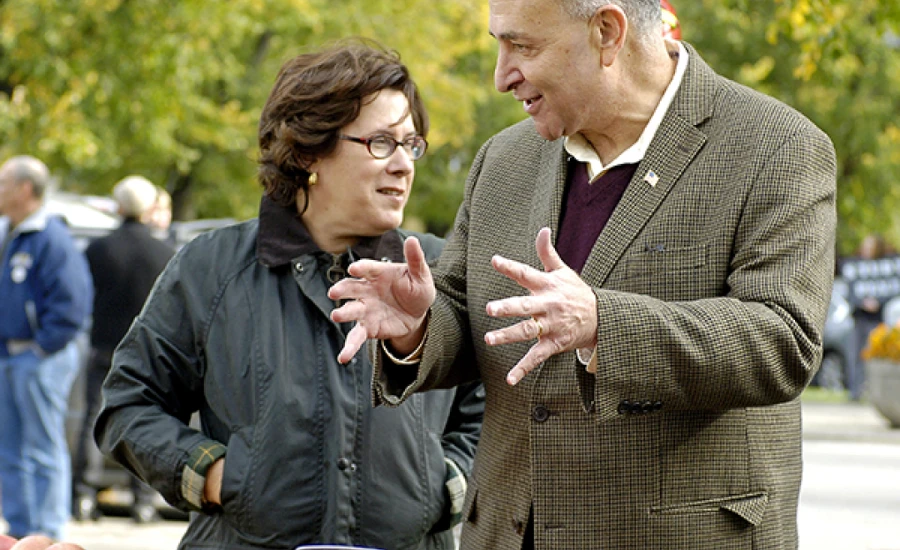
It was the late 1970s. Both Chuck Schumer and Iris Weinshall showed up at a Mid-Bay Independent Democrats meeting in Brooklyn. Schumer was a young state assemblyman. Weinshall was working as a lobbyist for the Citizens Union, there to drum up an endorsement. The meeting was transactional at first. She needed something. He was charming. She let him go first in line.
Something clicked. They kept talking.
They married on September 21, 1980 — just two weeks after Schumer won his Democratic nomination for Congress. The reception was held at Windows on the World, the restaurant perched at the very top of the World Trade Center’s north tower. It was, in every sense, a New York wedding. A city event, for city people, at the highest point in the city itself.
That day marked a fork in the road. Schumer’s trajectory pointed toward Washington. Weinshall’s pointed deeper into New York. They chose to run parallel. And they’ve been doing it for more than forty years. That building no longer stands, but the marriage it witnessed does.
Career Rise: Inside the Machine
She didn’t arrive at power in a straight line. Weinshall spent years learning how large institutions actually function — from the inside, in rooms most people never see.
She served as Senior Vice President of the New York State Urban Development Corporation, overseeing the state’s overall economic development programs. She then moved to Regional Vice President at Integrated Resources, Inc., structuring limited partnerships for property acquisition. After that came the Financial Services Corporation, where she served as president. These weren’t glamorous roles. They were load-bearing ones.
From 1988 to 1996, she served as Deputy Commissioner for Management and Budget at the New York City Department of Environmental Protection. She followed that with the role of First Deputy Commissioner of the Department of Citywide Administrative Services. She learned budgets. She learned how contracts move. She learned that the difference between policy and reality is usually a procurement process.
Then came September 8, 2000 — the day Mayor Rudy Giuliani named her Commissioner of the New York City Department of Transportation. She had no traffic engineering background. That turned out to be an advantage.
Queens Boulevard came to the forefront almost immediately. For decades it had been New York City’s most lethal road. Over 27,000 people were injured on it in the second half of the twentieth century. The media had branded it the Boulevard of Death, and two competing newspapers were running full campaigns demanding action from the city.
Weinshall walked into her own engineers’ offices and asked them to make the street safer. They pushed back hard. Slow the traffic, they warned, and gridlock would back up all the way to the Queensboro Bridge. She overruled them. Within weeks, speed limits dropped, crossing times increased, and lighting and signage were improved. She later told reporters that her engineers had been “thinking from the motorist’s viewpoint.”
That line traveled. It defined her tenure.
As the changes took effect on Queens Boulevard, pedestrian casualties plummeted. A street that had been killing people for generations became something approaching ordinary. She wasn’t done. Close to $3 billion was spent rehabilitating the city’s East River bridges during her seven-year run, and thanks to new contractor incentive clauses, much of the work finished ahead of schedule. In 2003, she and Mayor Bloomberg launched the THRU Streets Program in Midtown — prohibiting turns off designated avenues between 3rd and 6th Avenues, cutting crosstown travel times by 25 percent.
She modernized the Staten Island Ferry fleet, oversaw the opening of a rebuilt Whitehall Terminal in Lower Manhattan in 2005, and handled the kind of daily operational load that most commissioners quietly dread. When she stepped down in January 2007, Mayor Bloomberg said she had overseen the lowest pedestrian fatality rate in the city’s recorded history.
Seven years reshaping the streets of the largest city in America. Then she walked into the next room.
On January 29, 2007, Weinshall announced she was leaving DOT to become Vice Chancellor for Facilities Planning, Construction and Management at the City University of New York. At CUNY, she oversaw capital construction across 24 campuses spread across all five boroughs. Seven more years. Different scale. Same discipline.
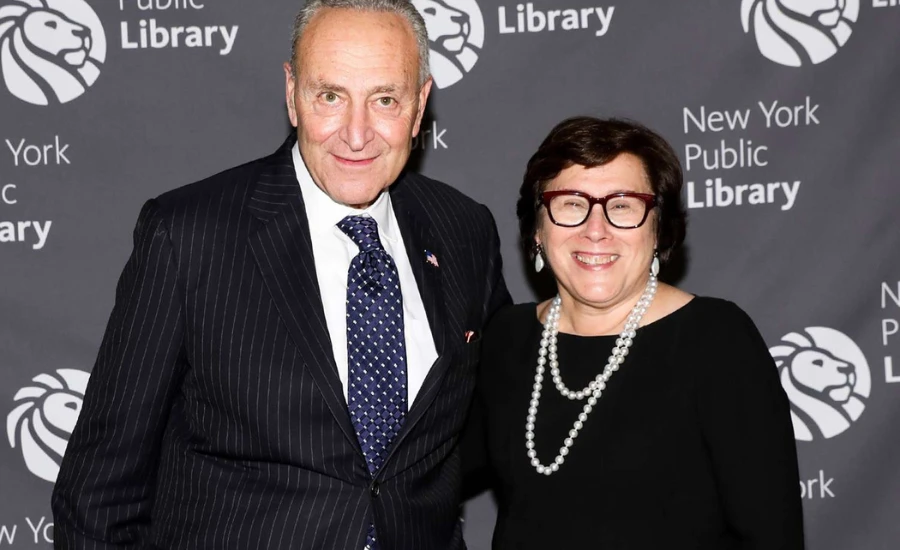
In July 2014, the New York Public Library appointed her Chief Operating Officer — a role that gave her responsibility for the library’s expense and capital budgets, a $1 billion endowment, and all construction projects across the system’s three-borough footprint. She started September 1, 2014. She’s still there.
Personal Life: Brooklyn, Always Brooklyn

There’s a version of this story where Iris Weinshall is defined entirely by whom she married. She refuses to cooperate with that version.
Schumer spends roughly four days a week in Washington. For years, the couple maintained a rule: calls in the morning and evening on every day he was away — often with him heading to the gym and her leaving work. He’d call from the airport asking if there was dinner. She’d say no. He’d eat cereal.
That detail matters. It’s a marriage between two people who have genuinely separate lives, and who’ve chosen to keep building toward each other anyway.
Their daughters — Jessica and Alison — both attended Harvard. Jessica went on to earn a law degree from Yale and has built a career at the intersection of law, policy, and nonprofit leadership. Alison moved into technology, working in policy and communications roles at Facebook and Instagram, and is now a public affairs manager at Airbnb. Alison is openly part of the LGBTQ community and is married to Elizabeth Weiland.
Iris chairs the Board of Directors of Prospect Park Alliance and has held that position since 2014. She and Schumer live directly across from the park — the same park where, as she puts it, she watched her daughters play softball on weekends for years. She’s been walking its paths her entire adult life. Now she helps govern it.
The family has grandchildren. Schumer talks about them often in public. Weinshall doesn’t — consistent with a private disposition she’s maintained across every chapter of her career. She shows up. She does the work. She doesn’t need the applause.
Controversies: The Hard Parts
No honest account of Iris Weinshall omits October 15, 2003. A Staten Island Ferry, the Andrew J. Barberi, slammed into a maintenance pier at St. George Terminal. Eleven people were killed. Seventy were injured, some critically.
The investigation found that her department had allowed patronage relationships to compromise safety operations at the ferry. The National Transportation Safety Board was direct in its criticism — citing systemic failures in oversight, safety protocols, and training under DOT’s watch. A court-appointed federal report echoed those findings, faulting top DOT leadership for inadequate supervision and for appointing an unqualified safety chief.
Weinshall responded by bringing in credentialed maritime professionals. In April 2004, she hired Captain James C. DeSimone, a thirty-year maritime industry veteran, as COO of the Staten Island Ferry, and shortly after brought in Margaret Gordon as executive director of Safety and Security. By October 2005, the DOT became the first ferry operator in the United States to voluntarily comply with an internationally recognized safety management regime.
She stayed on through the rest of her term. Whether that represents accountability in practice or political survival depends on who you ask.
The second controversy is murkier — and arguably more personal. Andrew Vesselinovitch, the department’s Bicycle Program Director, resigned in 2006 accusing Weinshall’s office of blocking bike lane installations and of ignoring known hazards on the Williamsburg Bridge — hazards already costing the city millions in lawsuits. He claimed a deputy commissioner told him to “butt out” when he tried to make repairs. Weinshall’s office disputed the characterizations. After her departure, her successor Janette Sadik-Khan installed over 200 miles of new bike lanes in just three years — a striking contrast to what the cycling community had seen under Weinshall.
Then came the bike lane on Prospect Park West — the street where Weinshall lives. She helped organize a group called Neighbors for Better Bike Lanes, aimed at removing a city-installed lane directly in front of her building. A lawsuit followed in 2011, supported by allies with political connections to Senator Schumer. Critics noted the obvious: a former transportation commissioner using her influence to fight a transportation project on her own block. The lawsuit was eventually dismissed. But the optics were poor and they lingered.
CUNY refused for years to release Weinshall’s email correspondence related to the Prospect Park West bike lane fight, claiming the records were personal and unrelated to her public duties. Advocacy journalists at Streetsblog sued to force disclosure and challenged the exemption in court. Reports emerged that Weinshall had worked to have CUNY-affiliated academics produce traffic studies that would support the anti-bike-lane position — using public university resources for what was, at its core, a private neighborhood campaign.
She never publicly addressed the conflict head-on. The lawsuit was eventually dropped. But the episode made permanent something that her critics had long suspected: that the same woman who overruled her engineers on Queens Boulevard wasn’t prepared to accept the same logic when the street in question was her own.
Current Life: Steward of a City’s Memory
As COO of the New York Public Library, Weinshall oversees one of the most beloved institutions in American public life. Her portfolio is enormous: expense and capital budgets, a $1 billion endowment, capital construction across 88 branches in Manhattan, the Bronx, and Staten Island. She manages Finance, Human Resources, Facilities, Communications, Capital Planning, and Government Relations.
It’s a different kind of power than she wielded at DOT. No traffic lights. No ferry terminals. Instead: the intellectual infrastructure of a city. The branch libraries in the Bronx where kids do homework after school. The reading rooms in Midtown where researchers still come with physical notebooks. The collections that span centuries and languages and forms of knowledge that can’t be Googled.
In May 2022, she was appointed to a five-year term on the Library of Congress Trust Fund Board a federal appointment that extended her reach beyond New York for the first time in her career.
She’s in her seventies now. She doesn’t appear to be slowing down.
Conclusion
The easiest version of Iris Weinshall’s legacy is Queens Boulevard. A road that once killed people with the quiet regularity of a public health crisis is now measurably safer, because one commissioner overruled her own engineers and forced them to think differently. That’s real. That’s permanent. People are alive who wouldn’t be.
The harder version of her legacy involves everything she resisted. Bike infrastructure that took years longer to arrive. Safety improvements blocked by internal politics. A Prospect Park West bike lane lawsuit that became a symbol of institutional hypocrisy — a former guardian of public streets using private leverage to keep change away from her front door.
Both versions are true. That’s what makes her interesting.
What’s undeniable is the scope. She ran the transportation system of New York City for seven years. She ran capital construction for the City University of New York for another seven. She’s now managed one of the great cultural institutions in America for over a decade. Each chapter was longer than most people’s entire careers in public service.
She rebuilt bridges. She reformed ferries. She put a $1 billion endowment to work for a library system that belongs to everyone. She raised two Harvard-educated daughters in a Park Slope brownhouse they bought in 1982 for $157,000. She walked Prospect Park on Sunday mornings while her husband was in Washington eating cereal.
New York City is not an easy place to leave a mark on. Iris Weinshall has left several.
FAQ: What People Want to Know About Iris Weinshall
1. Who is Iris Weinshall?
She’s an American public administrator born in Brooklyn in 1953. She served as NYC’s Transportation Commissioner from 2000 to 2007, then as CUNY Vice Chancellor, and since 2014 as Chief Operating Officer of the New York Public Library.
2. Who is Iris Weinshall married to?
U.S. Senator Chuck Schumer of New York. They married in 1980 and have been together for over four decades.
3. Where did Iris Weinshall grow up?
Brooklyn, New York. She attended Brooklyn College and has lived in Brooklyn for essentially her entire life.
4. What is Iris Weinshall’s educational background?
She graduated cum laude from Brooklyn College with a B.A. in political science, then earned a Master of Public Administration from NYU’s Wagner Graduate School of Public Service. Some sources also note a Master of Arts in Urban Studies from Queens College, though this is not consistently confirmed across all records.
5. What did Iris Weinshall accomplish as NYC’s Transportation Commissioner?
She’s most credited with the Queens Boulevard safety overhaul — dramatically reducing pedestrian deaths on one of the city’s most dangerous roads. She also oversaw nearly $3 billion in East River bridge rehabilitation, modernized the Staten Island Ferry fleet, and launched the Midtown THRU Streets program.
6. Who succeeded Iris Weinshall as DOT Commissioner?
Janette Sadik-Khan, who went on to install over 200 miles of bike lanes in just three years and became widely celebrated by urban cycling advocates.
7. What was the Staten Island Ferry crash controversy? On October 15, 2003, a ferry crashed into a pier, killing eleven people. Federal investigators faulted DOT — under Weinshall’s oversight — for safety failures and patronage-driven appointments in ferry operations. She remained in the job until 2007.
8. What is the Prospect Park West bike lane controversy?
After leaving DOT, Weinshall helped organize neighborhood opposition to a city-installed bike lane on the street where she lives. Critics pointed to the irony of a former transportation commissioner fighting a transportation safety measure. The resulting lawsuit was ultimately dismissed.
9. Does Iris Weinshall have children?
Yes. Two daughters — Jessica Emily Schumer and Alison Emma Schumer — both Harvard graduates. Jessica has pursued law and nonprofit work. Alison works in technology and is married to a woman named Elizabeth Weiland.
10. Where does Iris Weinshall live?
Park Slope, Brooklyn. She and Chuck Schumer bought their home there in 1982 for $157,000. They still live there today.
11. What does Iris Weinshall do now?
She serves as Chief Operating Officer of the New York Public Library, a role she’s held since September 2014. She also chairs the Board of Directors of Prospect Park Alliance and serves on the Library of Congress Trust Fund Board.
12. How did Iris Weinshall and Chuck Schumer meet?
At a political meeting in Brooklyn in the late 1970s. She was lobbying for the Citizens Union; he was a young state assemblyman. They got married in 1980.
13. What is Iris Weinshall’s net worth?
This is not publicly documented with precision. Reported figures for the Schumer household have been modest relative to their professional stature — Chuck Schumer’s reported net worth was approximately $702,000 as of 2014 reporting. Weinshall’s CUNY salary was reported at approximately $233,730 per year around 2010. Specific current figures are not publicly verified.
14. What was Iris Weinshall’s role at CUNY?
She served as Vice Chancellor for Facilities Planning, Construction and Management from 2007 to 2014, overseeing the university’s multi-year capital construction program across 24 campuses in all five boroughs of New York City.
15. Was Iris Weinshall appointed to any federal positions?
Yes. In May 2022, she was appointed to a five-year term on the Library of Congress Trust Fund Board by the appropriate appointing authority — bringing her expertise in institutional management to a national platform for the first time.