She was born in a displaced persons camp outside Munich in 1946, the child of Hungarian refugees who had survived a war and lost everything except each other. Her father was an artist. Her mother played concert violin. By the time Jaid was four, the family had packed up again and moved to Pennsylvania, starting over in a country they didn’t grow up in, building something from nothing for the second time.
That origin story — the camp, the violin, the second migration, the relentless forward motion — explains something about Jaid Barrymore that the easier narrative about her never quite captures. She wasn’t a villain who wandered into her daughter’s life and sabotaged it. She was a woman who survived displacement twice before the age of five, who spent her entire adult life chasing a dream that never fully materialized, and who made catastrophic parenting decisions while also being the only parent present at all. Both of those things are true simultaneously.
The world remembers her as Drew Barrymore’s mother. That’s understandable. It’s also the smallest version of who she actually was.
Quick Bio
| Full Name | Ildikó Jaid Makó (later Jaid Barrymore) |
| Born | May 8, 1946, Brannenburg, Bavaria, Germany |
| Parents | Hungarian refugees — father an artist, mother a concert violinist |
| Raised | Pennsylvania (from age 4), later Los Angeles |
| Marriage | John Drew Barrymore Jr. (married March 6, 1971; divorced February 9, 1984) |
| Children | Drew Blythe Barrymore (born February 22, 1975) |
| Grandchildren | Olive Barrymore Kopelman (b. 2012), Frankie Barrymore Kopelman (b. 2014) |
| Career | Actress, writer, voice actress |
| Notable Films | Night Shift (1982), Irreconcilable Differences (1984), Enchanted (1998), Searching for Bobby D (2005) |
| Books | Secrets of World-Class Lovers: Erotic Tips and Sensual Stories for a Lifetime of Sexual Fulfillment; Confidential (reported) |
| Playboy | September 1995 issue (“Drew’s Sexy Mom”) |
| Current Status | Private life; financially supported by Drew Barrymore per 2023 reporting |
Early Life: A Camp in Bavaria and a Piano in Pennsylvania
Brannenburg is a small Bavarian town near the Austrian border where, in the years after World War II, thousands of displaced Europeans were warehoused in camps while the continent tried to figure out what came next. Jaid was born into one of those camps on May 8, 1946. Her parents were Hungarian — one an artist, one a musician skilled enough to perform professionally. The details of how they ended up in Brannenburg, what they fled, and what they left behind are not part of the public record. Jaid has never elaborated publicly on that history.
What is confirmed is the timeline: the family emigrated to the United States around 1950, settling in Pennsylvania, when Jaid was approximately four years old. She grew up in the state, in a household where artistic ambition was clearly present — a painter and a violinist don’t produce children indifferent to creative life. Even as a girl, Jaid wanted to act. That desire never left her, even when nearly everything else in her life changed.
As a young woman, she moved to Los Angeles. She worked as a waitress. She worked side jobs at places including the Troubadour, the legendary West Hollywood music venue where everyone from Elton John to the Eagles had played. She was trying to build a career in a city that produces far more failed actors than successful ones, stretching her immigrant parents’ ambition into a new form in a new place.
She didn’t make it as an actress. Not in the way she dreamed. But she kept trying. That quality — the relentless forward push against indifferent odds — defined her, even when it led her into choices no responsible observer could defend.
The Turning Point: Marrying Into the Barrymores
Jaid Makó met John Drew Barrymore Jr. in the late 1960s and married him on March 6, 1971. She was twenty-four years old. He was the son of the legendary John Barrymore — considered by many critics of his era to be the greatest actor of his generation — and the grandson of actors going back to the 1880s. The Barrymore family was not just famous. It was American theatrical royalty, a dynasty that had produced more working actors across more generations than almost any family in the country’s history.
It was also a dynasty with a pronounced talent for self-destruction. John Drew Barrymore Jr. battled addiction throughout his life, had multiple arrests for drug-related offenses, and was by every account a chaotic and largely absent presence in the lives of the people who loved him. Jaid had already left him before Drew was born in February 1975 — separating from him due to his drinking, drug use, and abusive behavior. She raised their daughter alone from the start.
The Barrymore name she carried after the marriage was complicated inheritance. It opened certain doors in Hollywood. It also attached her permanently to a story that had never fully been hers. She was Jaid Mako before she was Jaid Barrymore. The world only ever knew the second version.
Career Rise: The Actress Who Never Quite Arrived
Jaid Barrymore’s acting career is a documented record of persistence without breakthrough. She got her first film role in Night Shift in 1982 — the Ron Howard-directed comedy starring Henry Winkler and Michael Keaton. The same year, a five-year-old Drew appeared in a dog food commercial Jaid had taken her to audition for, launched by a puppy that bit the child on the nose; Drew laughed instead of cried, got the part, and the trajectory of both their lives shifted.
Jaid appeared in Irreconcilable Differences in 1984 — ironically, a film about a child who legally divorces her parents, which would prove to be uncomfortably prophetic. Her filmography across the 1980s and early 1990s is composed primarily of minor roles in films that didn’t leave large footprints: Me, Myself and I (1992), Guncrazy (1992), Doppelganger (1993), Inevitable Grace (1994), Silent Prey (1997).
By the early 1990s she had landed a voice role in the animated series Eek! The Cat, which gave her a consistent credit for the first time. In the late 1990s and into the 2000s, a handful of additional roles came: Enchanted (1998), The Last Days of Disco (1998), Everything’s Jake (2000), Searching for Bobby D (2005). Her last confirmed film credit dates to approximately 2008.
She also wrote. Her book Secrets of World-Class Lovers: Erotic Tips and Sensual Stories for a Lifetime of Sexual Fulfillment was published and dedicated, notably, to Drew at a time when the two had been estranged for years. The dedication was partly a peace offering, partly a public gesture toward reconciliation. It produced a brief rapprochement. A second book, Confidential, was reportedly in development — described as containing more detailed accounts of her personal life, including reported relationships with Kiefer Sutherland, Jim Morrison, Jackson Browne, and James Taylor. Its publication status is unclear.
The career never matched the ambition. But she never stopped working it.
Personal Life: The Parenting That Defined and Destroyed
The story of Jaid and Drew Barrymore’s relationship is one of the most documented parent-child ruptures in modern Hollywood history, partly because Drew wrote about it herself in her 1990 autobiography Little Girl Lost, and partly because it keeps resurfacing every few years in interviews and profiles.
The basic facts are not in dispute. After the divorce from John Drew Barrymore was finalized in 1984, Jaid had sole responsibility for Drew. She also had no money, an acting career that wasn’t materializing, and a child who had been working professionally since she was eleven months old. The line between Drew’s mother and Drew’s manager blurred and eventually disappeared.
She took Drew to industry parties. She took her to Studio 54 when Drew was as young as four years old. Rock musicians Matthew and Grayson Nelson recalled bumping into Drew and Jaid at a club in 1986 — Drew was eleven — and immediately feeling protective of the child and suspicious of the mother. By Drew’s own account, she was smoking cigarettes at nine, drinking at eleven, using marijuana at twelve, and using cocaine at thirteen.
The nightlife wasn’t just neglect. It was functional access. Jaid, by multiple accounts, used Drew’s celebrity to get into clubs she couldn’t have entered alone. Drew’s stardom, purchased at the cost of a normal childhood, became currency Jaid spent.
In 1988, after Drew became violent trying to force Jaid out of the house, Jaid had her placed in rehabilitation at thirteen — at Van Nuys Behavioral Health Hospital, where she spent eighteen months. Drew attempted suicide at fourteen. She lived briefly with David Crosby and his wife Jan Dance, who provided the stability and commitment to sobriety that home had not. Then Drew filed for legal emancipation. A California court granted it.
At the hearing, Jaid appeared. She was, by Drew’s account, “in full support” of the emancipation. Drew felt sad about it. The judge signed off. Drew moved into her own apartment at fourteen and began rebuilding a career on her own terms.
Then came 1995. Drew posed nude for Playboy in January of that year, at nineteen, exercising what she described as reclaiming her own agency. Eight months later, Jaid posed in Playboy’s September 1995 issue, billed specifically as “Drew’s Sexy Mom.” The timing, and the billing, said everything there was to say about the dynamic that had defined their years together.
The reconciliations came in waves. Jaid dedicated her book to Drew. They reconnected briefly. They drifted apart. Drew married Tom Green in 2001 and Jaid gave her away. They drifted apart again. A 2023 New York Magazine profile of Drew reported that the two had never fully reconciled since Drew left at fourteen — and that Drew still financially supports her mother.
Drew’s 2023 comment — raw and inadvertently public — said she needed to grow “in spite of her being on this planet.” She immediately walked it back. She didn’t disown it. That tension, between love and damage, between care and resentment, between financial support and emotional distance, is where the relationship has lived for decades.
Controversies: Honest and Unflinching
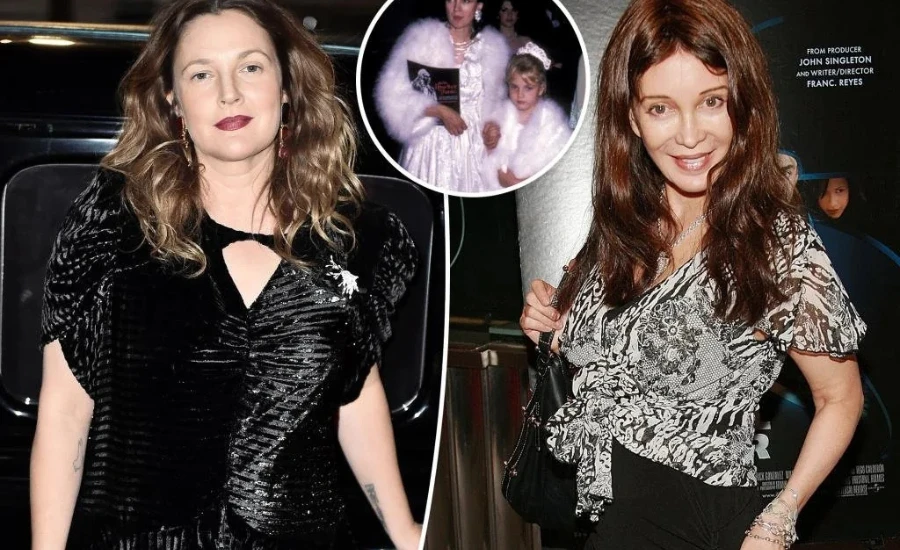
There is no way to write about Jaid Barrymore honestly without saying plainly what the documented record shows: she took her minor child to adult nightclubs as an entry strategy, allowed Drew to be exposed to drugs and alcohol throughout her early childhood, treated her daughter simultaneously as a client and a social accessory, and then posed in the same magazine as her daughter eight months later under a billing that made the dynamic explicit.
Matthew Nelson of the band Nelson told Page Six directly: “Her mother was a piece of work — she took her there, basically, to get into the club.” Drew herself wrote in her memoir: “She had lost credibility as a mother by taking me to Studio 54 (so wrong, but so fun) instead of school.” That parenthetical — “so fun” — is characteristic of Drew, who has never been straightforwardly angry about any of it, and who has consistently refused to frame the whole story as purely victimization.
The Playboy situation is worth separate consideration. Drew’s choice to pose was her own, made at nineteen, as an adult, and she has defended it. Jaid’s choice to follow her into the same publication eight months later, under that specific marketing description, is harder to defend on any terms. It drew significant criticism at the time and has aged poorly.
Jaid has never publicly owned these criticisms in direct terms. She wrote Confidential with the intention of explaining “why she did the things that she did,” according to Encyclopedia.com. Whether that book was ever fully published, and what it contained, is not clearly established in the public record.
What is also documented — and less frequently discussed — is that Jaid was ultimately the one who sent Drew to rehabilitation. She was the one who showed up at the emancipation hearing in support. She was the one Drew called when she wanted someone to give her away at her 2001 wedding. The relationship is not a clean story of damage with no love in it. It’s a messy story of both.
Current Life: Quiet, Supported, Unknown
As of 2026, Jaid Barrymore is 79 years old. Her last confirmed film credit dates to approximately 2008. She has not appeared in public events or media in documented form in recent years.
The 2023 New York Magazine profile of Drew reported that Drew sends her mother money — that Jaid is financially supported by her daughter. The profile noted the two have never fully reconciled. Drew mentions Jaid in Mother’s Day tributes and has on multiple occasions expressed both residual love and unresolved complexity about the relationship.
Where Jaid lives — whether in California or elsewhere — is not publicly confirmed. She maintains no known public social media presence. No interviews have surfaced. No public appearances have been documented recently.
She raised Drew Barrymore. Drew Barrymore became one of the most successful and beloved actresses in Hollywood history, built a production company, launched a talk show, wrote bestselling books, and raised two daughters she’s described as raising with entirely different values than the ones she inherited. Those two daughters — Olive and Frankie Kopelman — are Jaid’s grandchildren. Whether Jaid is a presence in their lives is not part of the public record.
Legacy: What She Left Behind and What She Didn’t
Jaid Barrymore’s legacy is not the one she set out to build. She came to Los Angeles wanting to be an actress. She became, instead, one of the most analyzed stage mothers in the history of celebrity culture — and the subject of a continuing conversation about parental boundaries, childhood fame, and the costs that never appear in the box office receipts.
She came from a displaced persons camp and made it to Hollywood. She survived the collapse of a marriage to a self-destructive man and raised a child alone. She worked for decades in an industry that gave her very little in return. She wrote books. She found her way into the rooms she wanted to be in, by whatever means were available.
And she made choices that left her daughter in rehabilitation at thirteen and emancipated at fourteen and still, in her late forties, telling magazines she has to grow “in spite of her mother being on this planet.”
Both of those things belong to the same life. A woman who was resilient enough to survive the postwar chaos she was born into and determined enough to chase her dreams across an ocean — and who failed, in the most consequential way possible, at the one responsibility that mattered more than any of it.
Drew has never stopped sending the checks. That’s the most complicated legacy of all.
You may also like Anna McEnroe
FAQ
1. Who is Jaid Barrymore?
Jaid Barrymore, born Ildikó Jaid Makó on May 8, 1946, in Brannenburg, Bavaria, Germany, is an American actress and writer best known as the mother of Drew Barrymore. She was formerly married to actor John Drew Barrymore Jr.
2. Where was Jaid Barrymore born? I
n a displaced persons camp in Brannenburg, Bavaria, West Germany. Her parents were Hungarian refugees. The family emigrated to Pennsylvania when Jaid was approximately four years old.
3. What is Jaid Barrymore’s real name?
She was born Ildikó Jaid Makó. She took the Barrymore surname when she married John Drew Barrymore Jr. in 1971 and has continued using it publicly.
4. What films did Jaid Barrymore appear in?
Her filmography includes Night Shift (1982), Irreconcilable Differences (1984), Me, Myself and I (1992), Guncrazy (1992), Doppelganger (1993), Inevitable Grace (1994), Enchanted (1998), The Last Days of Disco (1998), Everything’s Jake (2000), and Searching for Bobby D (2005), among others. Her last known film credit was around 2008.
5. Why did Drew Barrymore become emancipated from Jaid?
Drew filed for legal emancipation at fourteen after years of exposure to drugs, alcohol, and nightclubs, following multiple stints in rehabilitation and a suicide attempt. A California court granted the emancipation. Jaid appeared at the hearing and supported the decision.
6. Did Jaid Barrymore pose for Playboy?
Yes. She posed for the September 1995 issue, eight months after Drew’s January 1995 Playboy appearance. The magazine marketed Jaid’s spread with the description “Drew’s Sexy Mom.” It drew significant public criticism.
7. What books did Jaid Barrymore write?
She wrote Secrets of World-Class Lovers: Erotic Tips and Sensual Stories for a Lifetime of Sexual Fulfillment, which was dedicated to Drew. A second book, Confidential, was reportedly in development. The full publication status of the second book is unclear.
8. Are Drew Barrymore and Jaid Barrymore on speaking terms?
Their relationship has alternated between estrangement and reconciliation over decades. A 2023 New York Magazine profile reported they have never fully reconciled since Drew’s emancipation, though Drew continues to financially support her mother and mentions her in public tributes.
9. Did Jaid Barrymore manage Drew’s acting career?
Yes. After separating from John Drew Barrymore, Jaid acted as Drew’s manager and was responsible for taking her to auditions and guiding her early career. Multiple sources describe the manager-mother boundary becoming increasingly unclear as Drew’s fame grew.
10. Who were Jaid Barrymore’s parents?
Her father was an artist and her mother was a concert violinist. Both were Hungarian refugees. Their names are not part of the public record.
11. Did Jaid Barrymore attend Drew Barrymore’s wedding? Yes. When Drew married Tom Green in July 2001, Jaid gave her away at the ceremony.
12. How old is Jaid Barrymore?
Born May 8, 1946, she is 79 years old as of 2026.
13. Where is Jaid Barrymore now?
Her current residence is not publicly confirmed. Multiple sources suggest she lives in California, but this is unverified. She maintains no known public presence and has not made documented public appearances in recent years. Drew Barrymore reportedly continues to support her financially.
14. Is Jaid Barrymore still alive?
Yes, as of available reporting through 2025, Jaid Barrymore is alive.
15. Did Jaid Barrymore have a relationship with Drew’s father after their divorce?
The two separated before Drew was born and divorced in 1984. John Drew Barrymore Jr. remained largely absent from Drew’s life and died in 2004. There is no documented post-divorce relationship between Jaid and John beyond their shared parenthood.