
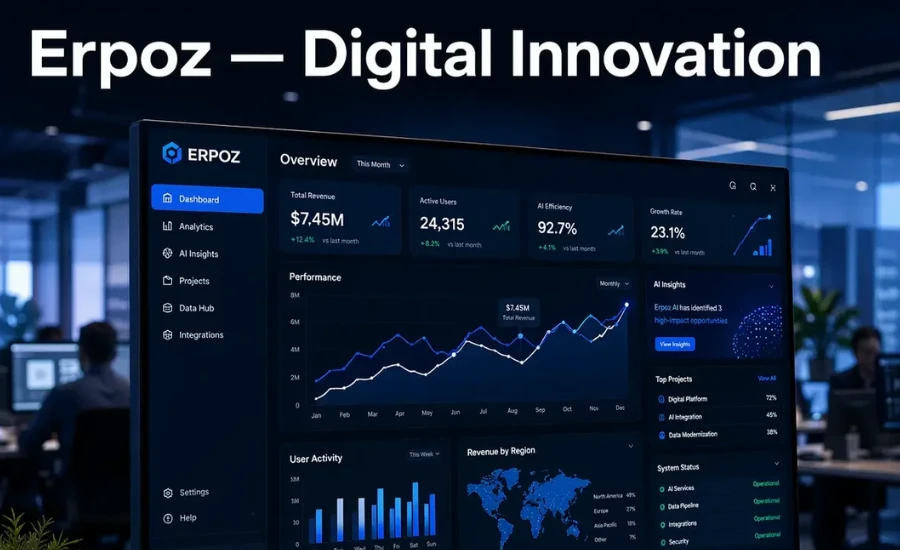
Read enough about “Erpoz” and a strange pattern emerges. Several articles confidently describe it as a cloud-based ERP platform — a real category of business software that genuinely exists. They give it pricing, between fifty and five hundred dollars a month. They give it a founding period, the late 2010s. They give it case studies — a retail chain, an e-commerce brand, a manufacturing company. One article even gives it a different identity entirely: a vintage tractor hydraulic seal. Cross-check any of these claims against an actual company registry, app store listing, or independent product review site, and nothing comes back. Erpoz is not one product with conflicting reviews. It is a name with no fixed product behind it at all.
Quick Reference Table
| Factor | Detail |
|---|---|
| Claimed Identity One | Cloud-based ERP software platform for SMEs and enterprises |
| Claimed Identity Two | A general “digital framework” and business mindset |
| Claimed Identity Three | A hydraulic seal and tractor part designation |
| Claimed Founding Date | “Late 2010s” — stated with no source |
| Verified Company Behind It | None found |
| Verified Product Listing (App Store, Capterra, G2) | None found |
| Verified Pricing Page | None found |
| Verified Customer Case Study | None — all examples are unnamed, generic companies |
| Verified Hydraulic Parts Catalog Listing | Could not be independently confirmed beyond a single source |
| Number Of Conflicting Articles Reviewed | At least nine |
| Self-Aware Source Admitting Uncertainty | Yes — one article states plainly it has no standardized definition |
The ERP Story: Specific, Detailed, and Unverifiable
The most common claim about Erpoz is the most elaborate one. Multiple articles describe it as a real, functioning cloud-based Enterprise Resource Planning platform — software that centralizes accounting, inventory, sales, and customer data into one system, the kind of tool real businesses genuinely rely on.
The level of invented specificity here is worth pausing on. One article claims a retail company using Erpoz saw a 30 percent increase in efficiency in its first quarter. Another describes an e-commerce brand increasing conversion rates by 20 percent using its analytics tools. A third walks through a detailed, fictional case study of a “mid-sized fashion retailer in an emerging market with 5 stores,” complete with specific before-and-after numbers — a jump from chaotic stock discrepancies to 98 percent inventory accuracy, and an 18 percent increase in repeat purchases.
None of these companies are named. None of these statistics are sourced. None of these case studies link to an actual case study page, press release, or any independent verification. This is a pattern worth recognizing on sight: specific-sounding numbers attached to vague, unnamed companies, designed to create the impression of evidence without providing anything a reader could actually check.
One article goes further, providing a specific pricing range — fifty to five hundred dollars per month — and a specific origin story, claiming the platform was “launched in conceptual form in the late 2010s and gaining traction through various rebrandings and adaptations.” No company name is given for who did this launching or rebranding. No version history exists anywhere else. This is invented biographical detail for a company that cannot be shown to exist.
The Generic Framework Story: Even Vaguer

A second cluster of articles avoids the specific ERP claims and instead describes Erpoz in much vaguer terms — a “digital framework,” a “mindset,” a “platform model designed to bring alignment between people, processes, and technology.”
This language is recognizable from other invented or unverifiable search terms covered in similar investigations. It is constructed to sound substantive while committing to nothing checkable. Phrases like “Erpoz sits right in the middle — powerful enough for enterprises, accessible enough for first-time users” and “the importance of Erpoz lies in its ability to adapt to changing needs” could be inserted into an article about literally any unnamed software product without changing a single fact, because there are no facts in these sentences to begin with.
One particularly telling detail: several of these vague-framework articles include the phrase “from what I’ve seen” repeatedly, attempting to lend a personal, experienced-analyst voice to the piece. This is a common technique to simulate firsthand authority. No specific instance described actually demonstrates direct experience with a real, named product — the observations remain generic enough to apply to any software category.
The One Source That Tells the Truth
Buried among the confident, detailed descriptions is a single article that breaks from the pattern entirely, and it deserves direct credit for doing so.
This source states plainly that Erpoz “appears to be an emerging digital term used in online ecosystems, software discussions, or branding contexts” and that “unlike established concepts, it does not yet have a standardized academic definition.” It goes on to lay out, honestly, that when a term lacks formal documentation, the most likely explanations are that it is a newly launched product not yet widely covered, a niche technical framework, or a brand-driven keyword designed to attract search attention. It directly advises readers to check for a registered company, transparent leadership, and independent reviews before trusting any specific claims — explicitly warning that “if all reviews sound identical,” that is itself a red flag.
This is, by a wide margin, the most honest and genuinely useful piece of content reviewed for this article. It does not pretend to know what Erpoz is. It tells the reader how to find out for themselves, and flags the absence of verification as a real concern rather than papering over it with invented case studies.
The Hydraulic Parts Claim: A Single, Unconfirmed Source
The most unusual claim about Erpoz comes from a single article describing it as a real mechanical part designation — specifically, hydraulic seals and components used in vintage tractors made by Lamborghini Trattori and Porsche-Diesel, with named example products like a “Merit Malta 5002 ERPOZ sealing ring” and “ERPOZ DM45 multi-section valve blocks.”
This is a genuinely different kind of claim from the ERP and “digital framework” descriptions — it is specific, narrow, and would in principle be checkable against real machinery parts catalogs, distributor listings, or manufacturer documentation. That specificity makes it more credible-sounding than the vague business-platform language elsewhere. However, no independent parts catalog, distributor website, or manufacturer page beyond this single source could be found to confirm either the “Merit Malta 5002” product or the “ERPOZ DM45” valve block as real, listed items.
This does not necessarily mean the claim is false — hydraulic parts catalogs for vintage agricultural machinery are a genuinely obscure, low-documentation corner of the internet, and a real but extremely niche part naming convention could plausibly exist with very little online footprint. But a single uncorroborated source making a specific factual claim is not the same as a confirmed fact, and readers genuinely searching for tractor hydraulic parts under this name should independently verify with a named parts distributor before purchasing anything based on this claim alone.
What This Pattern Reveals
Taken together, these competing descriptions reveal something useful about how unfamiliar search terms get filled in by content production rather than genuine research.
A name with ambiguous or unclear origins generates search curiosity. Different content creators, working independently and without cross-referencing each other, each construct their own plausible-sounding explanation for what the term must mean, drawing from whatever category seems most likely to generate engaged search traffic — business software being an extremely popular and lucrative content category. The result is not one wrong answer, but several different wrong answers competing for the same search term, each with no awareness of or connection to the others.
This matters because a person specifically searching for “Erpoz” is not being told “we don’t know what this is.” They are being told five or six different, mutually exclusive, confident things — each delivered with the structure and tone of a verified explainer article. That confidence is the problem. Genuine uncertainty dressed as confident expertise is more misleading than an honest “this is unclear,” because it actively discourages the reader from doing the verification they would otherwise know to do.
What You Should Actually Do
If you encountered the term Erpoz somewhere specific — a sales email, a software recommendation, a tractor parts listing — and want to know what it actually refers to, the path forward depends entirely on where you saw it.
If it appeared in the context of business software or ERP systems, search for the specific company name, founder, or registration details rather than the generic term. Check Capterra, G2, or Trustpilot for independently verified user reviews. Look for the platform on the Better Business Bureau or your country’s business registry. If none of this turns up a real, named company, treat any specific claims — pricing, case studies, statistics — as unverified marketing copy rather than fact.
If it appeared in a tractor or hydraulic machinery context, contact a named parts distributor directly, or check manufacturer documentation from Lamborghini Trattori or Porsche-Diesel directly, rather than relying on a single web article’s claim about a specific part number.
If you are being asked to pay for, sign up for, or share data with something calling itself “Erpoz,” apply the standard verification checklist that the most honest source reviewed for this article recommended: confirm a registered company name, check for transparent ownership, and look specifically for independent reviews that are not uniformly positive, since uniformly positive reviews with no specific complaints are themselves a warning sign.
You may also like 610-373-3759 233b
FAQ
1. What is Erpoz?
There is no single, verified answer. Different sources describe it as a cloud-based ERP business platform, a vague “digital framework,” and a hydraulic parts designation for vintage tractors. No verified company, registered business, or independent product listing supports any of these descriptions as a confirmed, real product.
2. Is Erpoz a real ERP software company?
No verified evidence supports this. No company name, founder, registered business entity, or independent review platform listing (such as G2 or Capterra) was found for Erpoz as an ERP product, despite detailed claims about pricing and case studies in several articles.
3. Are the case studies about Erpoz real?
They cannot be verified. The case studies described — a retail chain, an e-commerce brand, a fashion retailer — are all unnamed, with no links to actual press releases, named companies, or independently confirmable sources.
4. Is Erpoz a real hydraulic part used in tractors?
This specific claim comes from a single source describing parts like a “Merit Malta 5002 ERPOZ sealing ring” used in Lamborghini Trattori and Porsche-Diesel tractors. No independent parts catalog, distributor, or manufacturer page beyond this one source could be found to confirm it.
5. Why do so many different descriptions of Erpoz exist?
This pattern is consistent with multiple independent content creators each constructing a plausible-sounding explanation for an unfamiliar or ambiguous search term, without cross-referencing each other or confirming a real underlying product. Business software is a particularly common category for this kind of speculative content because of its commercial search value.
6. Has anyone admitted that Erpoz’s meaning is unclear?
Yes. One source reviewed for this article states directly that Erpoz lacks a standardized definition and recommends readers verify company registration, leadership transparency, and independent reviews before trusting any specific claims about it.
7. Should I pay for or sign up for an “Erpoz” platform if I encounter one?
Not without independent verification. Confirm a real, named company exists, check for reviews on independent platforms rather than testimonials on the platform’s own site, and verify data protection practices before sharing any personal or payment information.
8. Is Erpoz dangerous or a scam?
This cannot be confirmed either way. No evidence suggests active fraud, but the complete absence of a verifiable company behind detailed commercial claims means appropriate caution is warranted before any financial commitment.
9. Where did the name Erpoz come from? No source provides a confirmed origin. Claims about a “late 2010s” founding or industrial engineering origins are unsupported by independent evidence and should be treated as unverified.
10. Is there a real ERP platform I should consider instead?
Established, independently verifiable ERP platforms with confirmed companies, named founders, and independent reviews include options like NetSuite, Odoo, SAP Business One, and Zoho ERP, depending on business size and needs. These can be verified through G2, Capterra, and direct company websites.
11. Why do articles about Erpoz include fake-sounding statistics like “30% increase in efficiency”?
This is a common content technique used to make a description sound evidence-based without actually citing a real, checkable source. Specific-sounding numbers attached to unnamed companies should be treated as illustrative marketing language rather than verified data.
12. What’s the safest way to research an unfamiliar term like Erpoz?
Search for the term alongside words like “company,” “founder,” or “reviews,” check independent business registries and review platforms, and be especially cautious of any source that provides only positive, generic claims with no specific, checkable company information.