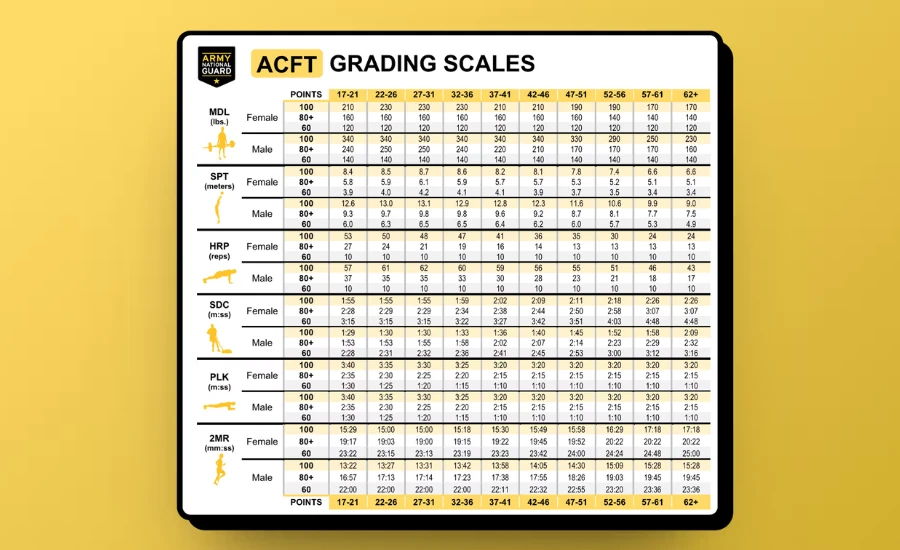
If you are searching “ACFT score chart” in 2026, you need to know this before anything else: the ACFT no longer exists as the Army’s official fitness test.
Effective June 1, 2025, the U.S. Army replaced the Army Combat Fitness Test (ACFT) with the Army Fitness Test (AFT) under Army Directive 2025-06. ACFT scores expired September 30, 2025 and are no longer valid for promotion, compliance, or any career eligibility in any Army system.
If you are an active soldier in 2026, you are tested on the AFT — not the ACFT.
This article covers both: the historical ACFT standards that many soldiers trained under and want to understand, and the current AFT standards that apply in 2026. Understanding both helps you compare legacy scores, prepare for what is actually tested now, and avoid the most common scoring mistakes documented across both systems.
ACFT vs. AFT: The Key Differences at a Glance
| Feature | ACFT (2020–May 2025) | AFT (June 2025–present) |
|---|---|---|
| Events | 6 | 5 |
| Removed event | N/A | Standing Power Throw (SPT) eliminated |
| Maximum score | 600 points | 500 points |
| Minimum per event | 60 points | 60 points (unchanged) |
| General standard total | 300 points (≥60 per event) | 300 points (≥60 per event) |
| Combat standard | No formal dual-standard | 350 points for 21 combat MOSs |
| Gender scoring (general) | Sex- and age-normed | Sex- and age-normed (unchanged) |
| Gender scoring (combat) | N/A | Sex-neutral, age-normed |
| Body composition exemption | 540-point threshold | 465-point threshold |
| Score validity | Expired September 30, 2025 | Current |
| Official document | ACFT scoring tables | AFT Scoring Scales PDF, June 2025 |
The Five Current AFT Events (What Is Actually Tested in 2026)
The AFT evaluates soldiers across five events. Each event scores 0–100 points for a maximum total of 500 points.
1. Maximum Deadlift (MDL)
What you do: Lift the maximum weight possible for three consecutive repetitions using a 60-pound hex (trap) bar with added weight plates.
What it measures: Lower-body and posterior-chain strength — the same muscle groups used to lift casualties, heavy equipment, and combat loads in the field.
Scoring range: 60 points (general pass) requires approximately 140 lbs for most age bands. 100 points (maximum) requires 340 lbs for combat MOS soldiers in the 17–21 age band. Scores vary by age band and standard (general vs. combat).
Key technique note: The hex bar requires a specific lifting technique different from a straight barbell. Graders enforce form standards strictly — improper technique results in no-count repetitions or event termination.
2. Hand-Release Push-Up (HRP)
What you do: Complete as many repetitions as possible in two minutes. The hand-release standard requires fully extending both arms outward after each descent — hands must visibly leave the ground before the next push.
What it measures: Upper-body pushing strength and endurance (chest, shoulders, triceps) plus trunk control to maintain a rigid body position throughout.
Key note: The hand-release requirement makes this stricter than a standard push-up. Reps where hands do not visibly separate from the ground do not count.
3. Sprint-Drag-Carry (SDC)
What you do: Complete five 25-meter shuttle segments in sequence: sprint, drag a 90-pound sled, lateral shuffle, carry two 40-pound kettlebells, final sprint.
What it measures: Agility, speed, anaerobic power, and the ability to perform explosive physical tasks while fatigued — simulating combined-arms combat demands.
Key note: The five-segment structure creates unique fatigue patterns that cannot be replicated by other training modalities. Soldiers should practice the actual course configuration regularly.
4. Plank (PLK)
What you do: Hold a proper plank position — forearms flat, body straight — for as long as possible.
What it measures: Core strength and endurance. The scoring table increases with hold time.
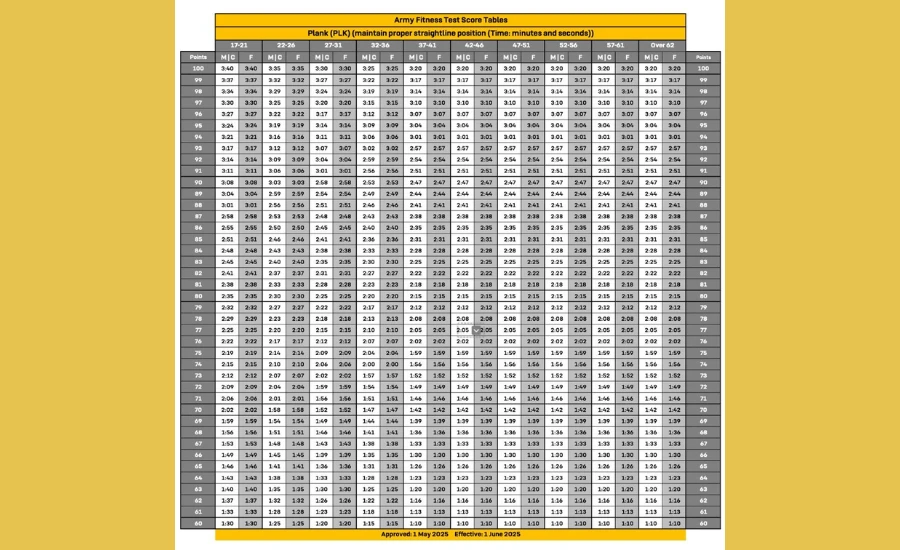
Approximate thresholds: Passing typically requires around 1:30 to 2:00 depending on age and standard. Maximum score typically requires 3:00 to 4:00+ depending on age band. Scores increase continuously with hold time, making this one of the most trainable events.
5. Two-Mile Run (2MR)
What you do: Complete a two-mile run as fast as possible on a measured flat course.
What it measures: Aerobic endurance — the foundational cardiovascular capacity underlying sustained combat operations.
Approximate thresholds (general standard, age 17–21 male): 60 points at approximately 15:54. 100 points at approximately 13:00 or faster. Thresholds increase (more time allowed) with age, and vary between the general and combat standards.
Key note: The 2MR remains one of the highest-influence events because the point differential between minimum-pass and maximum is large. Improving your run time has an outsized effect on total score.
The Removed Event: Standing Power Throw (SPT)
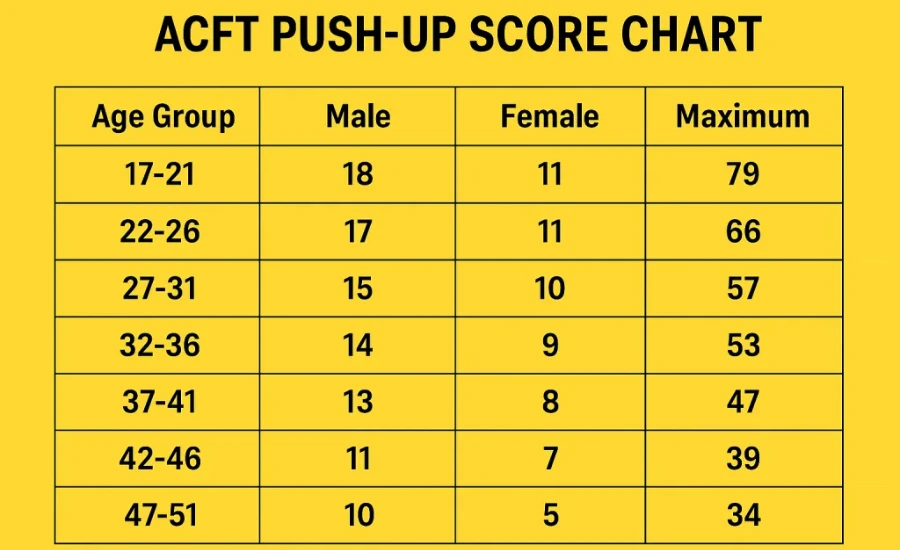
The ACFT included a sixth event that the AFT permanently eliminated: the Standing Power Throw.
What it was: Throw a 10-pound medicine ball backward overhead as far as possible. Measured explosive lower-body and posterior-chain power.
Why it was removed: RAND Corporation’s analysis of nearly one million ACFT administrations identified the SPT as the primary source of musculoskeletal injuries during Army fitness testing. The Army eliminated it to reduce injury risk without significantly compromising the test’s ability to assess combat-relevant physical qualities — the remaining five events collectively cover the same physical domains.
Important: Any source listing six events as the current AFT standard is citing outdated ACFT information. The AFT has exactly five events and a maximum score of 500.
The Dual-Standard System: General vs. Combat
One of the most significant changes the AFT introduced is a formal dual-standard framework.
General Standard
Who it applies to: Most soldiers not in designated combat MOSs.
Requirements: 60 points or more on every event AND 300 or more total points.
Scoring approach: Sex- and age-normed — scoring tables differ between male and female soldiers and between age bands. The same raw performance produces different point values depending on age and sex.
Combat Specialty Standard
Who it applies to: Soldiers in 21 designated combat MOSs and AOCs, including 11A (Infantry Officer), 11B (Infantryman), 11C (Indirect Fire Infantryman), 12B (Combat Engineer), 18 series (Special Forces), 19 series (Armor), and others confirmed in HQDA guidance.
Requirements: 60 points or more on every event AND 350 or more total points.
Scoring approach: Sex-neutral, age-normed — the same scoring tables apply to male and female soldiers in combat MOSs. This is a substantive increase from the prior gender-normed approach for female soldiers in combat roles.
Enforcement timeline:
- January 1, 2026: Active Duty, AGR, Reserve Component on 60+ day orders
- June 1, 2026: National Guard and remaining Reserve Component
Voluntary reclassification window: Soldiers in combat MOSs (PVT–SSG, under 18 years total active federal service) who could not meet the 350-point combat standard were offered voluntary reclassification from September through December 2025. After enforcement deadlines, soldiers who fail combat standards and do not voluntarily reclassify are subject to mandatory reclassification action.
Historical ACFT Score Chart: What the Six-Event System Measured
For soldiers who trained under the ACFT and want to understand their legacy scores, the historical structure is as follows.
The ACFT had six events, each scored 0–100 points, for a maximum of 600 total points. The same 60-point-per-event floor applied. Passing required 60+ on every event and 300+ total.
The six ACFT events and their targets:
| Event | Physical quality tested | Legacy ACFT status |
|---|---|---|
| 3-Rep Max Deadlift (MDL) | Lower-body/posterior strength | Active in AFT (unchanged) |
| Standing Power Throw (SPT) | Explosive power | Removed from AFT |
| Hand-Release Push-Up (HRP) | Upper-body endurance | Active in AFT (unchanged) |
| Sprint-Drag-Carry (SDC) | Agility/anaerobic power | Active in AFT (unchanged) |
| Plank (PLK) | Core endurance | Active in AFT (unchanged) |
| Two-Mile Run (2MR) | Aerobic endurance | Active in AFT (unchanged) |
Five of the six events survived intact. Only the Standing Power Throw was removed.
Score conversion caution: ACFT scores (out of 600) cannot be directly compared to AFT scores (out of 500) because the SPT event’s points are missing from the AFT total. A soldier who scored 480 on the ACFT would not necessarily score 400 on the AFT — their SPT points are simply absent. The four remaining events score identically under both systems, so per-event performance comparisons are valid; total score comparisons are not.
The Most Common Scoring Mistakes
These errors appear consistently across both ACFT and AFT administrations.
Ignoring the 60-point-per-event floor. The minimum per event is absolute. Scoring 59 on any single event — even with a 540 total — means automatic failure. Soldiers who train for total score while neglecting one weak event fail despite strong overall performance.
Using the wrong age or gender table. Scoring tables are specific to age band and, for the general standard, sex. A 35-year-old female soldier using the 17–21 male column gets a completely wrong estimate. Confirm your age band (your age on test day, not your birth year) and which table applies.
Misapplying the interpolation rule. If your raw performance falls between two values on the scoring table, you always receive the lower point score — not an average and not the higher score. Many soldiers overcounted their points by rounding up.
Confusing ACFT and AFT totals. The ACFT scored out of 600; the AFT scores out of 500. Comparing an ACFT total to an AFT total directly is not meaningful.
Treating ACFT scores as still valid. ACFT scores expired September 30, 2025. They no longer count for promotion, compliance, or career eligibility in any Army system. Using an ACFT score for any 2026 official purpose is an error.
Assuming SPT still exists. The Standing Power Throw is permanently removed. Preparing for a six-event test in 2026 wastes training time on a retired event.
Score Benchmarks and What They Mean for Your Career
Under the current AFT (out of 500 total):
| Score Range | What It Indicates |
|---|---|
| Below 300 (or below 60 on any event) | Failing — general standard. Triggers additional support, authorized retest |
| 300–349 | Minimum passing (general standard). Not sufficient for combat MOS |
| 350 (with 60+ per event) | Minimum passing for combat MOS soldiers |
| 400–450 | Above-average performance; competitive for promotion points |
| 450–480 | Top 20% of soldiers; exceptional fitness |
| 480+ | Top 5%; elite fitness, near-maximum per-event performance |
| 465+ | Qualifies for body composition program exemption under AR 600-9 |
Promotion implications: AFT scores feed into semi-centralized promotion calculations. AFT general scores must be recorded in DTMS for promotion points from October 1, 2025. AFT Combat scores must be recorded in DTMS from January 1, 2026. Maximum promotion points from fitness: 120 points (unchanged from ACFT).
Failing twice: Failing two consecutive AFTs triggers separation proceedings. No administrative action was taken during the transition period (through December 31, 2025), but enforcement began January 1, 2026 for the active component.
How to Read the Official AFT Scoring Tables
The authoritative source for exact scoring numbers is the AFT Scoring Scales PDF published effective June 1, 2025, available at army.mil/aft.
The tables are organized as follows:
- Identify whether you fall under the General Standard or Combat Standard based on your MOS/AOC.
- For the General Standard: locate your sex-specific table. For the Combat Standard: use the single sex-neutral table.
- Within your table, locate your age band. Age bands are determined by your age on test day, not your birth year. Soldiers near a band boundary should confirm with their S1 which band applies.
- For each event, find the row matching your raw performance (weight lifted, reps completed, time achieved, or plank duration).
- Apply the interpolation rule: if your raw result falls between two rows, use the lower point value.
- Sum the five event scores for your total.
Online calculators at armyapex.com, aftcalculatorscore.com, and armycftcalc.com automate this process — input your raw event results and receive instant scores. These calculators are widely used but not official. Always verify against the official PDF for career-relevant decisions.
Training Priorities for the AFT in 2026
Based on the scoring structure and event design, these training approaches have the highest return on investment.
Two-mile run: The largest point differential of any event. Running 800-meter intervals twice weekly produces faster time improvements than steady-pace jogging for most soldiers.
Sprint-Drag-Carry: Cannot be effectively trained without running the actual five-segment course. The unique fatigue pattern of transitioning between drag, shuffle, and carry requires specific adaptation. Run the actual course at least twice weekly.
Plank: One of the most trainable events. Holding a plank daily and adding 10 seconds per week consistently moves soldiers from minimum-pass to 80+ points within 6–8 weeks.
Deadlift: Train specifically with the hex bar — technique differs from a straight barbell and the difference affects both performance and injury risk. Posterior-chain work (Romanian deadlifts, hip hinges, glute bridges) transfers directly.
Hand-Release Push-Up: The hand-release requirement demands consistent practice. Volume training — multiple sets throughout the day — builds endurance faster than single maximal-effort sessions.
Key Dates and Policy Milestones
| Date | Event |
|---|---|
| June 1, 2025 | ACFT replaced by AFT as official test of record |
| September 30, 2025 | ACFT scores expire; no longer valid for any Army purpose |
| October 1, 2025 | AFT general scores begin counting for promotion points in DTMS |
| December 31, 2025 | End of transition protection period; no adverse action for AFT failures before this date |
| January 1, 2026 | AFT Combat Standard enforced for Active Duty, AGR, Reserve on 60+ day orders |
| June 1, 2026 | AFT Combat Standard enforced for National Guard and remaining Reserve |
Where to Find Official Information
army.mil/aft — The official U.S. Army AFT page. Includes the AFT Scoring Scales PDF (June 2025), FAQs, policy documents, and official implementation guidance. This is the authoritative primary source for all standards.
Army Directive 2025-06 — The formal policy directive replacing the ACFT with the AFT. Governs enforcement dates, dual-standard framework, and administrative provisions.
AR 600-9 — Army Regulation governing the Body Composition Program. The 465-point AFT score exempts soldiers from body composition assessment.
FM 7-22 and ATP 7-22.01 — Army doctrine publications on physical readiness training, used by commanders and H2F professionals to develop AFT preparation programs.
Final Words
The ACFT score chart has become one of the most searched military fitness topics because millions of soldiers trained under ACFT standards and want to understand their legacy performance.
But in 2026, the ACFT is retired. The test of record is the AFT — five events, 500-point maximum, dual-standard framework, with combat MOS enforcement in full effect. ACFT scores have been expired since September 30, 2025.
The most important shift between the two systems is structural rather than physical: removing the Standing Power Throw reduced injury risk and cut the test to five events, while the new combat standard changes what it means to be a soldier in a combat MOS — particularly for female soldiers who now face sex-neutral scoring thresholds in those roles.
For 2026 testing, training, and career planning: use the AFT score chart, train for five events, and confirm your standard (general or combat) with your unit S1.
You may also like Tiimatuvat
FAQ: 12 Real Questions About the ACFT Score Chart in 2026
1. Is the ACFT score chart still relevant in 2026? As a historical reference, yes — millions of soldiers trained under ACFT standards and want to understand legacy scores. For active Army testing, promotion, or compliance purposes: no. The ACFT was replaced by the AFT on June 1, 2025, and ACFT scores expired September 30, 2025.
2. What replaced the ACFT? The Army Fitness Test (AFT), effective June 1, 2025, under Army Directive 2025-06. The AFT has five events (the ACFT had six), a 500-point maximum (the ACFT had 600), and a new dual-standard framework distinguishing combat from general service soldiers.
3. What event was removed when the ACFT became the AFT? The Standing Power Throw (SPT) — a backward overhead medicine ball throw testing explosive power. It was removed because RAND Corporation analysis of nearly one million ACFT administrations identified it as the primary source of musculoskeletal injuries during testing.
4. What are the five AFT events in 2026? Maximum Deadlift (MDL), Hand-Release Push-Up (HRP), Sprint-Drag-Carry (SDC), Plank (PLK), and Two-Mile Run (2MR). Each scores 0–100 points for a 500-point maximum total.
5. What is the minimum passing score for the AFT? Every soldier must score at least 60 points on each individual event — no exceptions. Total minimums are 300 points (General Standard, most soldiers) or 350 points (Combat Standard, 21 combat MOSs). Scoring 59 on any single event means automatic failure regardless of your total.
6. What is the Combat Standard and who does it apply to? A sex-neutral, age-normed standard requiring 60+ points per event and 350+ total points, applied to soldiers in 21 designated combat MOSs and AOCs including Infantry, Armor, Combat Engineer, Special Forces, and others. “Sex-neutral” means the same scoring tables apply to both male and female soldiers — a significant change from the previous gender-normed approach.
7. When did the Combat Standard go into effect? January 1, 2026 for Active Duty, AGR, and Reserve Component soldiers on 60+ day orders. June 1, 2026 for National Guard and remaining Reserve Component soldiers.
8. Can I still use my ACFT score for promotion in 2026? No. ACFT scores expired September 30, 2025. AFT general scores have counted for promotion point calculations from October 1, 2025, and AFT combat scores from January 1, 2026. Any ACFT score is now invalid for all official Army purposes.
9. How do ACFT and AFT total scores compare? They cannot be compared directly. The ACFT scored out of 600 (six events at 0–100 each); the AFT scores out of 500 (five events at 0–100 each). Per-event scores for the four surviving events score identically under both systems, but total scores are not comparable because the SPT’s contribution is simply absent from the AFT.
10. What is the AFT body composition exemption threshold? 465 points on the AFT, under AR 600-9. This replaced the ACFT’s 540-point exemption threshold. Soldiers scoring 465 or higher on the AFT are exempt from body composition assessment.
11. What happens if a soldier fails the AFT? Failing one AFT triggers additional support resources (H2F) and an authorized retest. Failing two consecutive AFTs can trigger separation proceedings. No adverse administrative action was taken for AFT failures during the transition period (through December 31, 2025).
12. Where can I find the official AFT scoring tables? Army.mil/aft — the official U.S. Army AFT page — hosts the AFT Scoring Scales PDF published June 1, 2025 and all supporting policy documents. This is the only authoritative source. Online calculators (aftcalculatorscore.com, armyapex.com, armycftcalc.com) can help you estimate scores but should be verified against the official PDF for career-relevant decisions.