
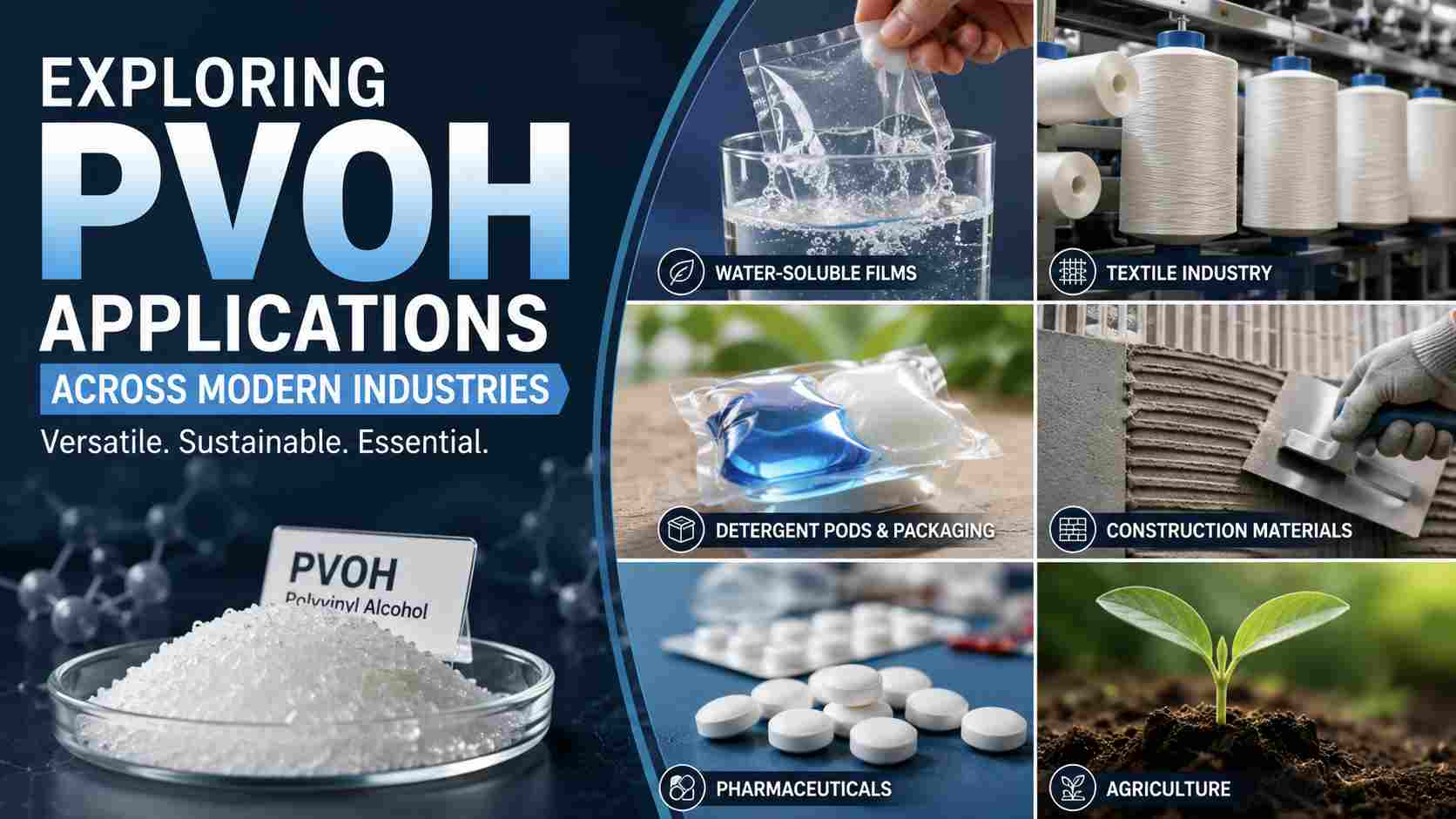
PVOH Applications continue to expand across manufacturing because polyvinyl alcohol offers a valuable combination of water solubility, film formation, adhesion, binding strength, and resistance to oils and many organic solvents. Its performance can be adjusted by changing molecular weight and degree of hydrolysis, allowing formulators to select grades with different viscosity, flexibility, solubility, and water resistance. These adaptable characteristics make the polymer useful in products ranging from paper coatings and textile sizing to adhesives, ceramics, construction compounds, and water-soluble packaging. Polyvinyl alcohol manufacturers therefore supply multiple grades designed for specific processing methods and final performance requirements.
Adhesives represent one of the most established PVOH Applications. The polymer can provide strong bonding to porous materials such as paper, cardboard, wood, and textiles while supporting stable water-based formulations. It may be used directly as a binder or as a protective colloid in polymer emulsions. In label adhesives, bookbinding products, packaging glues, and construction mixtures, PVOH can improve tack, cohesion, viscosity control, and storage stability. The most suitable grade depends on solids content, application speed, drying conditions, and the required balance between open time and final bond strength.
The paper industry relies on PVOH for surface sizing, pigment binding, barrier coatings, and improved printability. When applied to paper or board, the polymer can form a smooth film that strengthens the surface and reduces dusting or fiber lifting during printing. It may also improve resistance to grease, oil, and oxygen under suitable conditions. Moisture sensitivity must still be managed through grade selection, crosslinking, blending, or multilayer design. Polyvinyl alcohol manufacturers often work with paper producers to match solution viscosity and film performance with coating equipment, drying capacity, and target end use.
Textile processing includes important PVOH Applications. Yarns experience tension and abrasion during weaving, so a temporary protective film is applied to reduce breakage and improve efficiency. PVOH can create a strong yet flexible coating that reduces hairiness and helps yarn withstand mechanical stress. After weaving, the sizing material can be removed during desizing and washing when the grade and process are properly matched. The polymer is also used in textile finishing, printing, and nonwoven binding. Consistent viscosity and dissolution behavior are essential for maintaining uniform pickup, predictable film strength, and efficient removal from the finished fabric.
Water-soluble films are among the most visible and innovative PVOH Applications. Carefully formulated films can hold measured quantities of detergents, cleaning chemicals, dyes, agricultural inputs, or other products and dissolve when exposed to specified water conditions. Unit-dose packaging can reduce direct contact with concentrated ingredients, support accurate dosing, and minimize product residue. Film performance depends on thickness, grade, plasticizer system, sealing conditions, humidity exposure, and desired dissolution temperature. A film intended to dissolve in cold water requires different properties from one designed to remain stable until it reaches a warm industrial process. Polyvinyl alcohol manufacturers must provide reliable raw material consistency because minor changes can affect extrusion, sealing, storage, and dissolution.
Construction materials use PVOH as a binder, protective colloid, and performance modifier in selected dry mixes, coatings, putties, joint compounds, and cement-related formulations. The polymer may improve cohesion, workability, adhesion, and the distribution of other ingredients. Its effectiveness depends on dosage and compatibility with cement, minerals, redispersible powders, cellulose ethers, and chemical additives. Too much polymer can change viscosity, drying, or water response, while too little may not provide the desired benefit. Formulators usually conduct controlled trials to identify a practical concentration. These PVOH Applications demonstrate how a relatively small quantity of functional polymer can influence both processing and final product performance.
Ceramic production also benefits from the binding and film-forming characteristics of PVOH. Before firing, ceramic powders must remain together during shaping, drying, handling, and machining. The polymer can improve green strength, reduce dust, and help particles form a more stable body. An effective temporary binder should distribute uniformly, provide adequate mechanical strength, and burn out cleanly during firing without causing unwanted pores, discoloration, or structural defects. Molecular weight, solution concentration, plasticizer choice, and burnout schedule all affect the result. Polyvinyl alcohol manufacturers serving ceramic customers may recommend grades according to powder type, forming method, required green strength, and furnace conditions.
Agricultural and seed-related PVOH Applications include coatings, binders, and controlled-delivery systems. A thin polymer layer can help agricultural powders or active ingredients adhere to seeds and other target surfaces. PVOH may also be considered in water-soluble delivery formats where a measured product must disperse during use. Formulation design should account for moisture, temperature, storage time, dissolution rate, and compatibility with active ingredients. Agricultural products are regulated differently across markets, so developers must confirm that every grade and additive is suitable for the intended use. Field and storage testing are necessary because laboratory film performance may change under real environmental conditions.
Environmental performance is increasingly important when evaluating PVOH Applications. Because PVOH can dissolve in water, it is sometimes incorrectly assumed that dissolution guarantees immediate or complete biodegradation. Dissolution simply disperses polymer chains into the water phase, while subsequent biodegradation depends on molecular characteristics, concentration, microorganisms, temperature, oxygen, and treatment conditions. Wastewater facilities and natural environments do not all provide the same conditions. Responsible suppliers and brands should avoid broad claims and use relevant testing to support environmental statements. Product design should also consider material efficiency, durability, manufacturing energy, packaging, transportation, and realistic disposal routes instead of focusing on a single property.
Choosing the right material requires close attention to grade specifications and supplier capability. Buyers should compare degree of hydrolysis, molecular weight, viscosity, solubility, residual content, ash, particle size, and batch consistency. They should also review certificates of analysis, quality systems, production capacity, traceability, packaging, lead times, and technical support. Samples should be tested on actual equipment before commercial orders are finalized. By matching polymer properties with processing conditions and end-use requirements, businesses can obtain dependable results across many PVOH Applications. Strong cooperation between customers and Polyvinyl alcohol manufacturers helps turn a versatile raw material into reliable films, coatings, adhesives, binders, and functional products for modern industry.