Habiba Abdul Jabbar parents traveled all the way from New York to Washington, D.C., to watch their daughter get married. They never made it inside.
Standing outside the mosque on May 28, 1971, Habiba’s mother and father were turned away at the door — their Catholic faith disqualifying them from witnessing the very moment their child began a new life. The groom reportedly didn’t even know this was going to happen until the ceremony had already started. He’d send televised “Hi to Moms and Pops in New York” shout-outs on national television for years afterward, trying to mend a wound that was never supposed to exist in the first place.
That moment tells you almost everything you need to know about the marriage of Habiba and Kareem Abdul-Jabbar. Two people, both newly committed to Islam, both genuinely in love — and yet surrounded, from the very first hour, by the kind of pressure that marriages rarely survive.
Most people know Kareem. Fewer know Habiba. Almost no one knows the full story of what she built after the cameras stopped paying attention.
Quick Facts
| Detail | Information |
|---|---|
| Birth Name | Janice Brown |
| Name After Conversion | Habiba Abdul Jabbar |
| Birthplace | New York, USA |
| Birth Year | Circa late 1940s–early 1950s (exact date unconfirmed) |
| Religion | Converted from Catholicism to Islam |
| Marriage | May 28, 1971 — 1978 (divorce finalized 1983) |
| Ex-Husband | Kareem Abdul-Jabbar (born Ferdinand Lewis Alcindor Jr.) |
| Children | Habiba Alcindor (b. 1972), Kareem Abdul-Jabbar Jr. (b. 1976), Sultana Abdul-Jabbar (b. 1979) |
| Education | California State University, Los Angeles; Oberlin College (Creative Writing, 1997) |
| Career | Model, fashion buyer, consultant, event planner, founder of Tutu Glam |
| Current Location | View Park, Los Angeles, California (per available reports) |
| Net Worth | Estimated $2–4 million (unconfirmed) |
Habiba’s exact birth date remains disputed across sources. Some cite October 1947, others say 1950. This article uses “circa late 1940s to early 1950s” to reflect that honest uncertainty rather than guess.
Where She Came From
Janice Brown grew up in New York, raised by Catholic parents who gave her a traditional Christian upbringing. She was, by most accounts, their only child. Details about her childhood, early schooling, and inner life are genuinely sparse — not because she had something to hide, but because she has simply never offered them up.
What we know is this: she was a high school student when she first crossed paths with the man who would change her entire world. She and Kareem were introduced through a mutual acquaintance named Cliff Anderson, a basketball player who was, at the time, dating Janice herself. She wasn’t looking for a basketball legend. She was just a teenager at a game.
There’s something quietly significant in that. The girl who would later convert her faith, change her name, and build an entirely new identity didn’t go searching for any of it. It found her on an ordinary evening in Los Angeles, standing next to someone else’s boyfriend, watching someone else play.
The Turning Point
Kareem — then still known as Lew Alcindor — invited her to watch a UCLA game. She said yes. He called. They went out. What began as casual became serious, and what was serious became something neither of them could walk away from easily.
Kareem had recently converted to Islam, and his commitment to the faith ran deep. It wasn’t ceremonial. It reshaped his worldview, his social circle, his name, and eventually his understanding of who he should marry. When Janice Brown converted and became Habiba, it wasn’t just a name change on a form somewhere. It was a full restructuring of identity — faith, community, name, and the entire direction of her life, rearranged in one deliberate act.
She was still a young woman. She made that call anyway.
Kareem later acknowledged publicly that his spiritual leader, Hamaas Abdul-Khaalis, played a significant role in recommending the match — and that at the time, he had genuine feelings for another woman. Whether the marriage was directed, suggested, or simply encouraged by faith leadership is not entirely clear. What is clear is that both parties entered a union carrying different emotional weights. Habiba built a marriage on ground that was already unsteady, and she did it with her eyes at least partially open.
The wedding ceremony was led by Hamaas Abdul-Khaalis of the Hanafi movement, inside a Washington, D.C. mosque. Her parents waited outside.
A Career Built On Her Own Terms

It’s easy — and lazy — to frame Habiba’s professional life as a footnote to Kareem’s. It wasn’t.
Early in her adult years, Habiba worked as a model for the Black Fashion Museum in America. This wasn’t a celebrity-wife hobby or a vanity project. It was a real entry point into an industry she took seriously. She followed that with work as a clothing buyer for a retail store in Los Angeles, learning the business side of fashion from the inside out.
After the divorce in 1978, she relocated to Seattle and worked as a fashion consultant. Moving cities after a high-profile divorce, with children to raise, and building a professional reputation from scratch in a new place — that’s not reinvention. That’s just doing the work.
The consulting work eventually gave way to something more personal: she founded Tutu Glam, her own apparel brand specializing in colorful, elaborate tutu skirts. Its customers ranged from professional dancers and cheerleaders to children and athletes. It’s a joyful brand — deliberately vivid, deliberately celebratory. For a woman who spent years living in the shadow of someone else’s enormous public life, there’s something almost quietly defiant about building a business out of pure, unapologetic sparkle.
Before launching Tutu Glam, she spent nearly eighteen years — from February 1993 to November 2011 — as an event planner for several nonprofit organizations. Eighteen years of service work, almost entirely invisible to the public eye, before stepping out with her own brand. She wasn’t in a hurry. She was building something real.
She graduated from Oberlin in 1997 with a degree in Creative Writing. Oberlin is one of the most academically demanding liberal arts colleges in the United States. She finished that degree in her late forties or early fifties, after raising three children through a complicated divorce and assembling a career from the ground up. Oberlin doesn’t hand out degrees. She earned it.
She had also attended California State University, Los Angeles at some point — though the precise sequence of her academic timeline varies across available sources and should be taken as approximate.
Marriage, Motherhood, and the Weight of Both
They separated in 1973. Two years into the marriage. Habiba was pregnant with their third child, Sultana, when the split became real. The divorce didn’t become legally final until 1983 — a full decade after they stopped living together.
Read that slowly. She was pregnant when he left. She had a child after that. And she spent five more years legally bound to a marriage that had already ended in everything but paperwork.
Three children under effectively single-parent conditions, during the exact years when Kareem was becoming the most dominant force in professional basketball. The Showtime Lakers. Six MVP awards. Championship parades. He got the glory. She got the school pickups.
Kareem has written candidly, in his later years, that he demanded a great deal from Habiba while providing very little emotional support in return. He was consumed by basketball. He was deepening his faith in ways that isolated the people closest to him. He was moving between cities. He acknowledged all of it, eventually. That honesty came decades later, long after Habiba had stopped waiting for it.
Her three children are a story in themselves. Daughter Habiba Alcindor — who prefers the name Bamba Alcindor on social media, deliberately separating her identity from her father’s — began her career as a script reader at the Wilma Theater, later worked at The Nation Magazine as communications coordinator, and has contributed journalism to publications including The Huffington Post and The New York Times. She is a writer and journalist. Her mother earned a Creative Writing degree in her late forties. The apple didn’t fall far.
Kareem Abdul-Jabbar Jr. played college basketball at Western Kentucky after attending Valparaiso, before eventually turning toward acting and television work. Sultana, the youngest, chose the furthest path from any spotlight — reportedly working in administrative roles, including a brief period with the Los Angeles Lakers organization, before settling into a fully private life.
Three children. Three different directions. All of them shaped by a woman who held the family together through years when holding it together was the hardest thing anyone in that house could have done.
Some sources also report that Habiba later married a second man identified as Mr. Herbert, and had a fourth child named Sean Herbert. This detail appears in a limited number of sources only and has not been independently verified. It is included here with that caveat stated plainly.
Controversies — Told Honestly
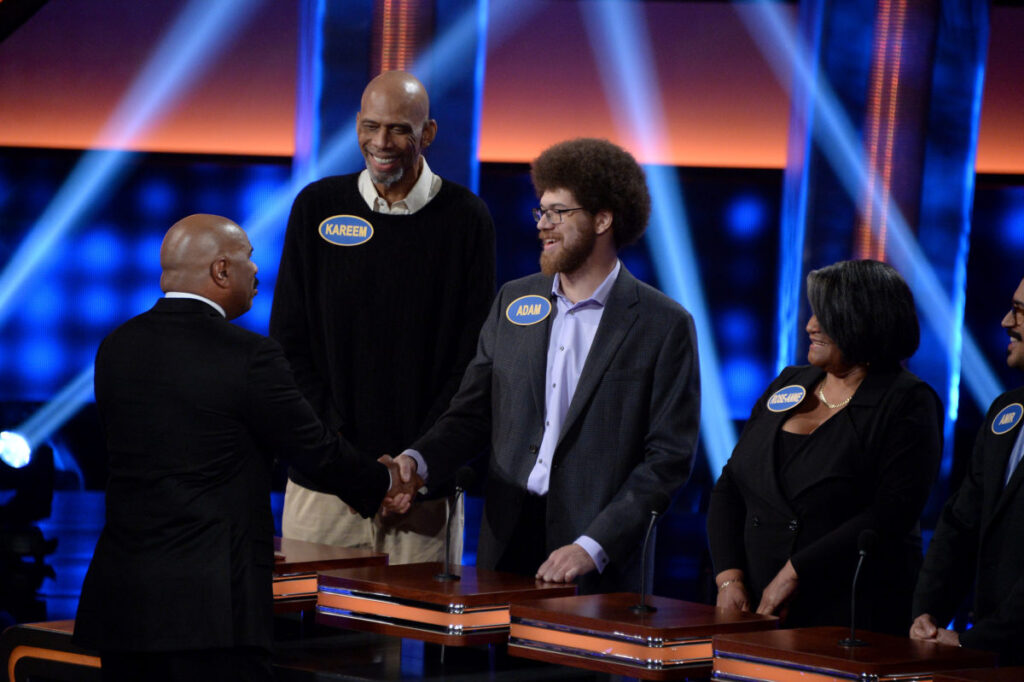
STEVE HARVEY, KAREEM ABDUL-JABBAR, ADAM ABDUL-JABBAR, ROSE-ANN SWANN
The circumstances surrounding this marriage deserve a direct look, not a polished one.
Kareem stated publicly that he married Habiba partly on the recommendation of his spiritual leader — despite having deep feelings for someone else at the time. That is not a small admission. It means the foundation of the marriage was complicated before the wedding even happened. Habiba deserved to know that. Whether she did or didn’t, nobody has said.
While still legally married to Habiba, Kareem became involved with a woman named Cheryl Pistono. Pistono later gave birth to his son Amir. Kareem and Pistono became engaged after the divorce but never married. This was never disputed and is part of the documented record of that period.
The Hanafi massacre of 1973 also cast a long shadow. Seven members of Kareem’s religious community — people he considered family, living in a home he had purchased for them in Washington, D.C. — were murdered in an attack that some accounts suggest was intended for Kareem himself. The grief and trauma from that event, combined with the chronic migraines he developed in its aftermath, created psychological weight that bent every relationship around him.
None of that was Habiba’s fault. None of it was within her control. She absorbed the fallout of a husband who was deeply damaged and deeply distracted, and she did it while pregnant, then postpartum, then effectively alone. She never spoke publicly about any of it. That is either extraordinary discipline or extraordinary dignity. Probably both.
Where She Is Now
Habiba Abdul Jabbar currently lives in the View Park area of Los Angeles, California, according to the most recent available information. She keeps no active public profile under her own name. She doesn’t give interviews. She doesn’t weigh in on Kareem’s memoir excerpts, the documentaries about his career, or the periodic waves of attention that follow his name.
She maintained a Facebook page called “RunHabibaRun” — which reflects a genuine passion for running and athletics — and ran the Tutu Glam brand, both of which served as the only digital breadcrumbs she left behind. Deliberately, one suspects.
She’s somewhere in her mid-to-late seventies now, by most available estimates. Her fashion work appears to have wound down in recent years. Her children are grown, each living on their own terms. She built exactly the kind of quiet life she always seemed to want — just on her own timeline, after a ten-year detour through one of the loudest stories in American sports.
The Creative Writing degree from Oberlin suggests an interior life that never needed a public audience to validate it. Whether that interior life produced a manuscript, a journal, a body of private work — nobody outside her circle knows. She hasn’t said. She won’t say.
Conclusion
Here is what Habiba Abdul Jabbar leaves behind, whether she intended to or not.
She raised three children through one of the more complicated domestic situations imaginable — a high-profile divorce, financial uncertainty, geographic disruption, and the constant background noise of being permanently associated with a man the world refused to stop talking about. Two of those children became serious contributors in public-facing fields. The third lives quietly and entirely on her own terms. That’s a 3-for-3 outcome by any honest measure.
She built a career in fashion from nothing: model, buyer, consultant, event planner, brand founder. She went back to school in her late forties and earned a degree in Creative Writing from one of America’s most demanding liberal arts institutions. She did all of it without publicists, without a platform, without a documentary crew following her around, and without asking anyone to notice.
The name Habiba is Arabic for “beloved.” She took that name as a young woman, as a single act of faith and commitment. She spent the next five decades making it mean something that had nothing to do with who she had married.
Her legacy isn’t a record or a championship ring. It’s the quieter proof that a woman can walk through a very loud chapter of someone else’s story and come out the other side with a life that belongs entirely to herself.
You may also like this one Kellie Kyle
Frequently Asked Questions About Habiba Abdul Jabbar
1. Who is Habiba Abdul Jabbar?
She is the former wife of NBA legend Kareem Abdul-Jabbar. Born Janice Brown in New York, she converted to Islam and changed her name upon marrying Kareem in 1971. She is also a fashion designer and the mother of three of Kareem’s children.
2. What was Habiba’s original name?
Janice Brown. She changed her name to Habiba Abdul Jabbar after converting to Islam just before her 1971 wedding ceremony.
3. When and where did Habiba and Kareem get married?
May 28, 1971. The ceremony was held at a mosque in Washington, D.C., and was officiated by Hamaas Abdul-Khaalis, leader of the Hanafi movement.
4. Why were Habiba’s parents turned away at the wedding?
Her parents were Catholic and were not permitted to enter the mosque. Kareem reportedly didn’t learn of this rule until the ceremony had already begun. The incident caused a serious early rift in the marriage.
5. Why did Habiba and Kareem divorce?
They separated in 1973, two years into the marriage. Officially cited reasons include emotional distance, Kareem’s involvement with another woman (Cheryl Pistono), and the immense personal pressures of his NBA career and spiritual life. The divorce was finalized legally in 1983.
6. How many children do they share?
Three: daughter Habiba Alcindor (born 1972), son Kareem Abdul-Jabbar Jr. (born 1976), and daughter Sultana Abdul-Jabbar (born 1979).
7. What does Habiba Abdul Jabbar do professionally?
She worked as a model for the Black Fashion Museum, a clothing buyer in Los Angeles, a fashion consultant in Seattle, and a nonprofit event planner for roughly eighteen years. She later founded Tutu Glam, her own apparel brand.
8. Where did Habiba Abdul Jabbar study?
She attended California State University, Los Angeles, and later graduated from Oberlin College in 1997 with a degree in Creative Writing.
9. What is Habiba Abdul Jabbar net worth?
Her net worth is not publicly confirmed. Estimates from media sources range from $2 million to $4 million. These figures are unverified. Kareem’s net worth is separately estimated at approximately $25 million.
10. Did Habiba remarry after Kareem?
Some sources report that she later married a man identified only as Mr. Herbert and had a child named Sean Herbert. This has not been independently confirmed and should be treated as unverified.
11. Where does Habiba Abdul Jabbar live today?
Reportedly in the View Park area of Los Angeles, California. She lives privately and does not engage with media.
12. What does the name “Habiba” mean? It is an Arabic name meaning “beloved.” It was chosen for her by Hamaas Abdul-Khaalis, the same spiritual leader who officiated her wedding.
13. Is Habiba Abdul Jabbar still Muslim?
There is no public information suggesting she changed her faith after her 1971 conversion.
14. What is Tutu Glam?
It is Habiba’s apparel brand, known for its colorful, flamboyant tutu skirts. The brand served customers including dancers, cheerleaders, athletes, and children.
15. What is the relationship between Habiba and Kareem today?
Both maintain very private lives. They appear to have kept an amicable co-parenting relationship over the decades. Neither discusses the other publicly in any meaningful way.