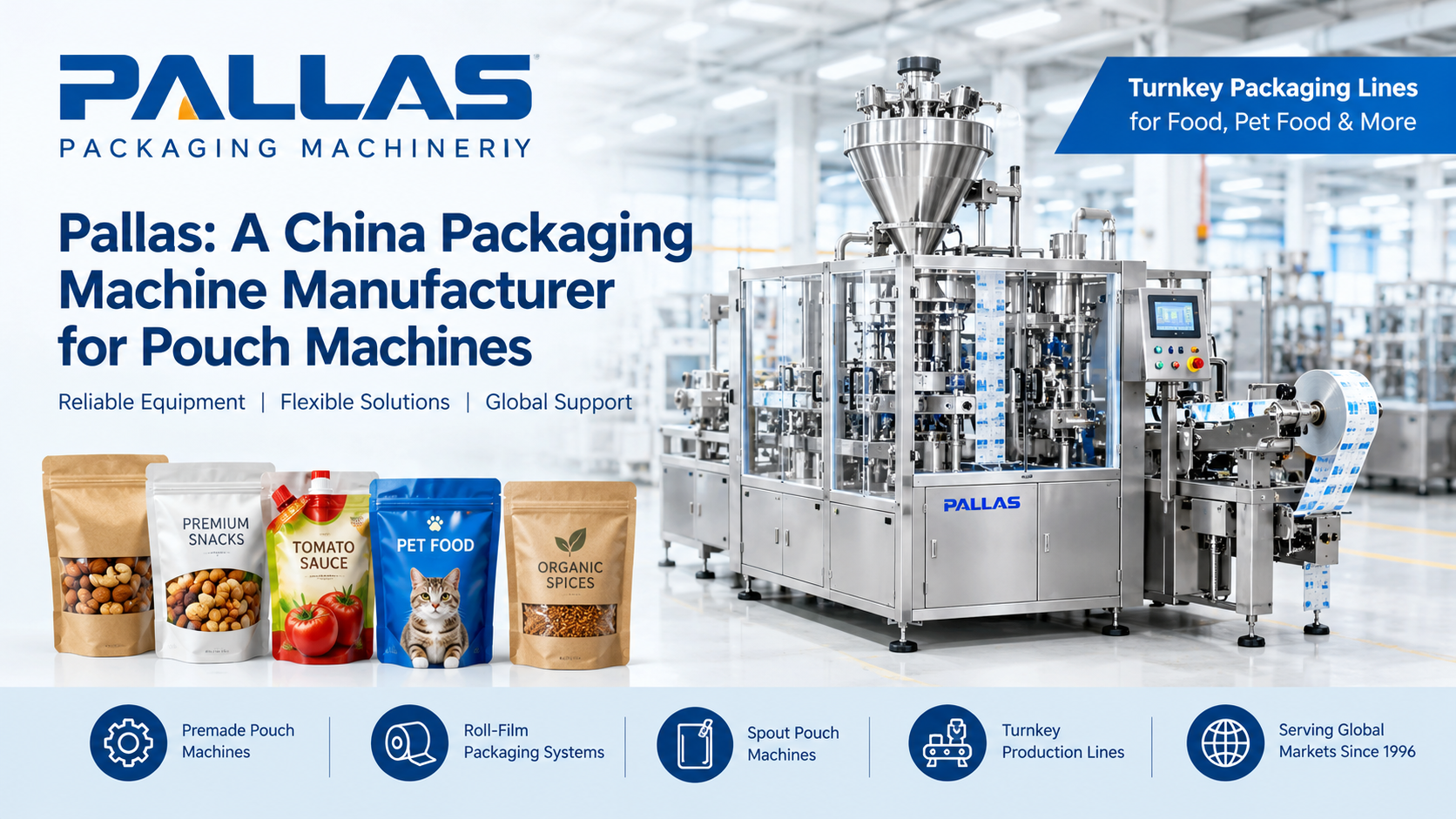
Pallas is a China-based packaging machinery manufacturer that focuses on automatic pouch packaging machines and integrated production systems. The company serves industries that require reliable equipment for filling, sealing, and preparing products for distribution. According to its official website, Pallas has worked in the packaging machinery industry since 1996 and supplies equipment to customers in international markets. Its product range includes premade pouch machines, roll-film packaging systems, spout pouch machines, and customized turnkey packaging lines. These solutions can help manufacturers organize their production processes, improve packaging consistency, and manage growing product demand. For businesses looking for a packaging equipment partner, understanding Pallas’s capabilities is a useful starting point when comparing machinery options. Source Pallas official.
Packaging Machines Offered by Pallas
Choosing the right packaging machine depends on the product, packaging material, required output, and factory workflow. Pallas offers several machine categories designed for different packaging applications, allowing manufacturers to select equipment that matches their operational needs. Its range includes systems for premade pouches, bags formed from roll film, liquid-filled spout pouches, and gusseted packaging formats. These machines can support products such as snacks, coffee, spices, powders, sauces, and pet food. Rather than selecting equipment based only on its advertised speed, businesses should consider filling accuracy, sealing quality, changeover requirements, and compatibility with their preferred packaging materials. The right combination of these features can help create a more consistent and manageable production process.
Premade Pouch Packaging Machines
Premade pouch packaging machines fill and seal bags that have already been manufactured, making them suitable for businesses that want to use established packaging designs. Pallas lists several premade pouch machine models that support different bag styles and production requirements. Depending on the machine configuration, these systems may handle stand-up pouches, flat pouches, zipper bags, and other compatible formats. They are useful for products such as nuts, dried foods, snacks, pet treats, and powdered ingredients. Automated pouch handling can reduce repetitive manual work while helping maintain consistent filling and sealing. Before purchasing a machine, manufacturers should confirm that it accommodates their actual pouch dimensions, material structure, filling weight, and required production speed.
Roll-Film and Spout Pouch Machines
Roll-film packaging machines form bags from a continuous roll of packaging material before filling and sealing them. This approach can be appropriate for manufacturers seeking control over bag dimensions and an efficient packaging process. Spout pouch machines, meanwhile, are designed for compatible flexible packages that include a spout, making them useful for liquids, sauces, pastes, and similar products. Pallas lists both roll-film and spout pouch equipment in its product range. The best choice depends on whether a business prioritizes flexible bag production, convenient liquid dispensing, or compatibility with an existing packaging design. Buyers should evaluate the product’s viscosity, filling temperature, sealing requirements, and packaging material before choosing a suitable configuration. Source: Pallas pouch packaging machines.
Turnkey Packaging Lines for Modern Production
A turnkey packaging line combines the equipment and processes required to move a product from preparation to finished packaging. Instead of sourcing every machine independently, a manufacturer can work with a supplier to coordinate feeding, weighing, filling, sealing, conveying, and other necessary operations. Pallas states that it provides turnkey packaging projects covering system design, equipment manufacturing, installation, and commissioning. This integrated approach can simplify project coordination and help reduce compatibility problems between separate machines. It can also give businesses a clearer understanding of how products move through the factory. However, a successful turnkey project requires careful planning, including production targets, available floor space, electrical requirements, hygiene needs, and future expansion plans.
Benefits of Integrated Packaging Systems
Integrated packaging systems help businesses improve production efficiency, reduce manual work, and maintain consistent packaging quality.
- Higher Efficiency: Streamlines multiple packaging processes.
- Reduced Labor: Minimizes repetitive manual tasks.
- Consistent Quality: Supports accurate filling and reliable sealing.
- Lower Downtime: Improves coordination between machines.
- Easy Expansion: Makes it easier to scale production as business needs grow.
Food Packaging Solutions
Food manufacturers need packaging equipment that supports consistent filling, secure seals, and appropriate product handling. Pallas lists applications for products such as snacks, spices, rice, nuts, sauces, and other food items, depending on the selected machine and filling system. Different products require different approaches: powders may need an auger filler, granules may benefit from a weighing system, and liquids generally require an appropriate pump or liquid-filling mechanism. Packaging material also matters because moisture, oxygen, light, and leakage can affect product quality and shelf life. Manufacturers should therefore consider the product’s physical properties alongside its packaging design. Food-grade contact materials, cleanable components, suitable sealing temperatures, and compliance with relevant food-safety requirements should be confirmed for the exact machine being purchased.
Pet Food Packaging Equipment
Pet food manufacturers need packaging solutions that can handle products ranging from dry kibble and treats to powders, supplements, and certain liquid products. Pallas identifies pet food as one of the industries served by its packaging machinery. Depending on the product and bag format, suitable equipment may incorporate weighing systems, pouch handling, filling, sealing, and conveying. Strong seals are particularly important because damaged packaging can expose food to moisture and contamination during storage and transportation. Manufacturers should also consider particle size, product weight, bag strength, and the possibility of crumbs or particles interfering with the sealing area. When evaluating equipment, businesses should conduct product trials using their actual pet food and packaging materials to verify filling accuracy, seal integrity, and production performance.
Customization and Production Efficiency
Every manufacturing facility has different requirements, so packaging equipment may need adjustments to suit a specific product, bag format, or factory layout. Pallas describes customized OEM and ODM projects for applications involving different materials, packaging formats, hygiene requirements, and production conditions. Customization may involve selecting a suitable filling mechanism, changing bag dimensions, integrating conveyors, or configuring controls to match the production process. These adjustments can help businesses avoid investing in equipment that does not fit their operations. However, customization should be based on clearly documented requirements rather than general expectations. Buyers should provide product samples, packaging specifications, target output, and available installation space so the manufacturer can recommend an appropriate configuration and confirm which features are included in the quotation.
Packaging Quality, Hygiene, and Product Protection
Packaging quality affects product presentation, storage performance, and customer confidence. An effective packaging system should deliver consistent filling, reliable sealing, and appropriate handling throughout the production process. For food and pet food applications, manufacturers should verify that product-contact components meet applicable hygiene requirements and that the machine can be cleaned according to the intended use. The packaging material must also suit the product’s moisture sensitivity, storage conditions, and distribution environment. Quality checks may include fill-weight verification, seal inspection, leak testing where applicable, and examination of finished packages. Although automation can improve consistency, it does not replace a well-designed quality-control process. Businesses should establish inspection procedures and confirm the machine’s performance under realistic operating conditions before beginning full-scale production.
How to Choose the Right Packaging Machine
Selecting suitable packaging machinery begins with understanding what the factory needs to produce today and what it may need to produce in the future. Buyers should identify the product type, filling weight, bag dimensions, packaging material, target output, and available production space. They should also decide whether premade pouches or roll-film packaging better match their product and marketing strategy. Comparing equipment specifications is more useful than relying on general claims about speed or efficiency because actual performance varies with product characteristics and machine configuration. It is also important to request demonstrations or product trials, confirm spare-parts availability, and clarify installation and training arrangements. A structured evaluation helps manufacturers compare Pallas with alternative suppliers and choose equipment based on practical requirements rather than price alone.
Maintenance, Technical Support, and Long-Term Value
The long-term value of packaging machinery depends on more than its initial purchase price. Routine maintenance, operator training, replacement parts, and access to technical assistance can all influence productivity over time. Before ordering from Pallas, businesses should ask about preventive maintenance schedules, warranty coverage, remote troubleshooting, spare-parts lead times, and technician availability in their region. Operators should receive clear instructions for cleaning, adjustments, safe operation, and identifying common faults. Manufacturers should also understand which components require regular replacement and how much downtime may be needed for servicing. A machine that fits the production process and receives proper maintenance can support more predictable operations. Comparing these ongoing costs alongside the purchase price provides a more realistic picture of the equipment’s overall value.
Why Businesses Consider Pallas
Businesses evaluating Pallas may be interested in its range of pouch packaging machines, experience in packaging machinery, and stated ability to deliver integrated production lines. Its equipment portfolio covers several packaging formats and product categories, including food and pet food applications. Having access to different machine types can be helpful for manufacturers that want to compare packaging methods or plan an expansion. The company also describes customized engineering and turnkey project services, which may be relevant when standard equipment does not meet a factory’s needs. Still, every purchase decision should be supported by a review of technical documentation, current certifications, product-trial results, commercial terms, and after-sales arrangements. Requesting references from comparable installations can provide additional information before a business makes a final investment.
Conclusion
Pallas is a China-based packaging machine manufacturer offering pouch packaging equipment and turnkey solutions for food, pet food, and other industries. Its product range includes premade pouch machines, roll-film systems, spout pouch equipment, and machinery that can be incorporated into integrated production lines. These options may help manufacturers improve packaging consistency, organize production, and prepare for changing demand. The best solution depends on the product, packaging format, required output, hygiene standards, and factory conditions. Businesses considering Pallas should verify machine specifications, request trials, and compare the full costs of installation, operation, and maintenance. With careful planning and a suitable equipment configuration, manufacturers can make a more informed decision about their packaging investment.
FAQs About Pallas
1. What does Pallas manufacture?
Pallas manufactures automatic packaging machinery, including premade pouch machines, roll-film packaging systems, spout pouch machines, and equipment for integrated packaging lines.
2. Can Pallas provide complete packaging lines?
Yes, Pallas states that it provides turnkey packaging projects that can include system design, manufacturing, installation, and commissioning.
3. Which products can Pallas pouch machines package?
Depending on the machine and filling system, applications include snacks, rice, nuts, spices, powders, sauces, liquids, and pet food.
4. Are Pallas packaging machines customizable?
Pallas offers customized OEM and ODM solutions designed around product characteristics, packaging formats, production capacity, and factory requirements.
5. What should buyers check before purchasing a Pallas machine?
Buyers should confirm product compatibility, bag dimensions, filling accuracy, production speed, safety and hygiene requirements, warranty terms, spare-parts availability, and technical support.