
A cubic yard is a cube measuring 3 feet on each side: 3 feet wide × 3 feet long × 3 feet deep. Because it is three-dimensional, the volume is 3 × 3 × 3 = 27 cubic feet. That number — 27 — is the one you need to remember. Every cubic yards calculation comes back to it.
The most common source of error with cubic yards is confusing volume with area. A square yard is flat — a surface measurement covering 9 square feet. A cubic yard has depth — a volume measurement filling 27 cubic feet. You cannot convert between them without knowing the third dimension: depth or thickness.
Core Conversions
| Unit | Equivalent |
|---|---|
| 1 cubic yard | 27 cubic feet |
| 1 cubic yard | 46,656 cubic inches |
| 1 cubic yard | 0.7646 cubic metres |
| 1 cubic yard | 764.6 litres |
| 1 cubic yard | ~202 US gallons |
| 1 cubic foot | 0.037 cubic yards (1 ÷ 27) |
| 1 cubic metre | 1.308 cubic yards |
To convert cubic feet to cubic yards: divide by 27.
To convert cubic yards to cubic feet: multiply by 27.
The Formula for Any Rectangular Area
For any flat, rectangular area — a garden bed, a driveway, a concrete slab, a mulch area:
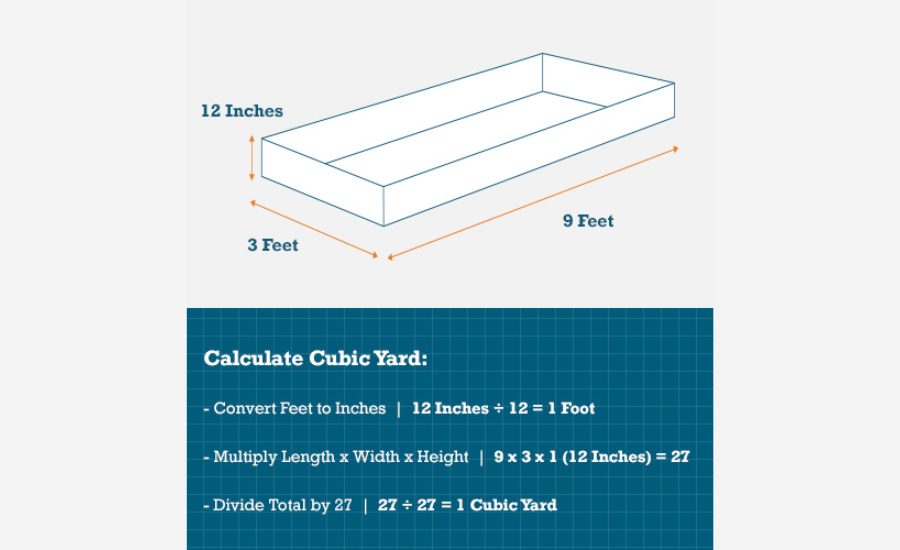
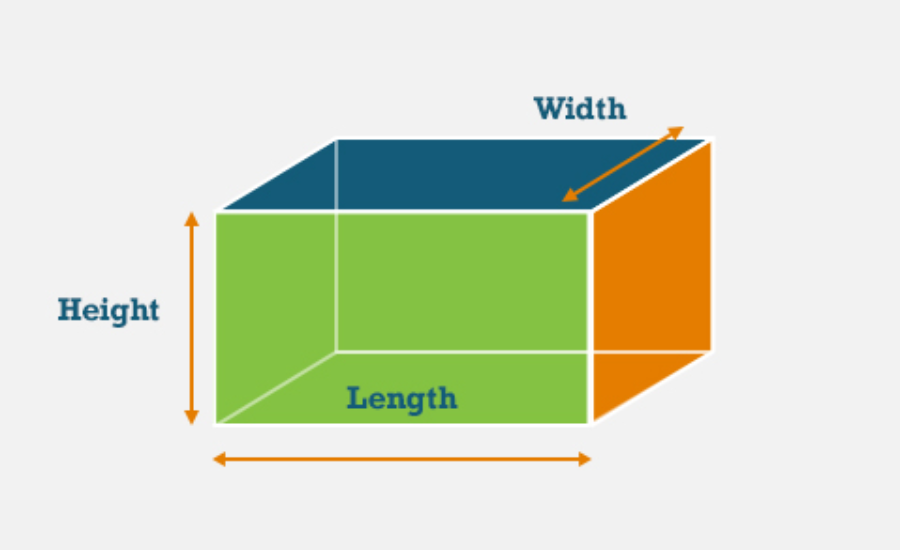
Cubic yards = (Length in feet × Width in feet × Depth in feet) ÷ 27
All three measurements must be in the same unit — feet — before dividing by 27. If your depth is in inches, convert it first: divide inches by 12 to get feet.
Example: A flower bed 12 feet long, 4 feet wide, and 3 inches deep.
- Convert depth: 3 inches ÷ 12 = 0.25 feet
- Calculate: 12 × 4 × 0.25 = 12 cubic feet
- Convert: 12 ÷ 27 = 0.44 cubic yards
Example: A concrete slab 20 feet long, 10 feet wide, 4 inches thick.
- Convert depth: 4 ÷ 12 = 0.333 feet
- Calculate: 20 × 10 × 0.333 = 66.6 cubic feet
- Convert: 66.6 ÷ 27 = 2.47 cubic yards
Coverage Table — How Much Area One Cubic Yard Covers
This table is the most useful single reference for landscaping and material ordering. It shows how many square feet one cubic yard of any material covers at a given depth.
| Depth | Coverage per Cubic Yard |
|---|---|
| 1 inch | 324 square feet |
| 2 inches | 162 square feet |
| 3 inches | 108 square feet |
| 4 inches | 81 square feet |
| 6 inches | 54 square feet |
| 9 inches | 36 square feet |
| 12 inches (1 foot) | 27 square feet |
Why these numbers: 1 cubic yard = 27 cubic feet. At 1 inch depth (1/12 of a foot), 27 ÷ (1/12) = 27 × 12 = 324 square feet. The math scales directly: double the depth, halve the coverage.
To find how many cubic yards you need for a specific area and depth:
Cubic yards = (Area in square feet × Depth in inches) ÷ 324
Example: 500 square feet of garden at 3 inches of mulch:
(500 × 3) ÷ 324 = 1,500 ÷ 324 = 4.6 cubic yards
Weight of One Cubic Yard by Material
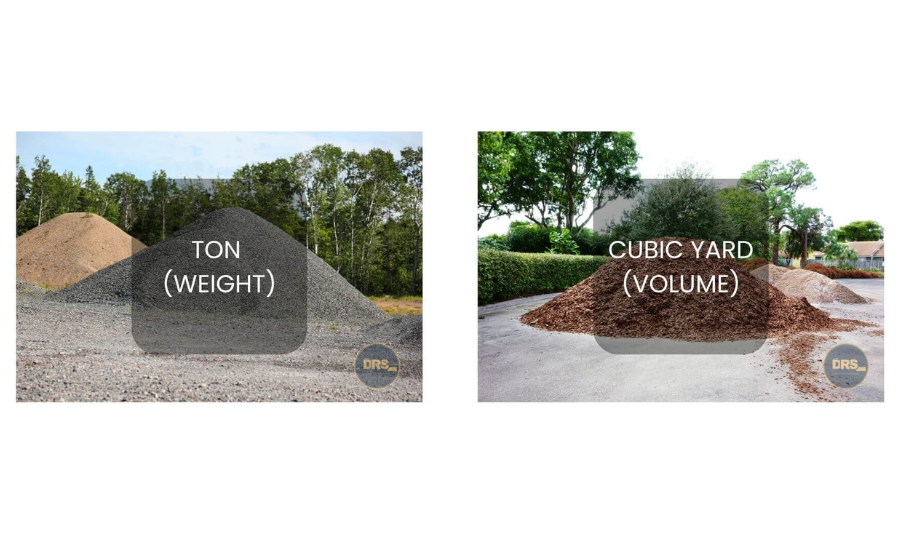
Volume and weight are different things. One cubic yard of gravel weighs far more than one cubic yard of mulch. Weight matters for truck capacity, delivery costs, and ground load.
| Material | Weight per Cubic Yard |
|---|---|
| Topsoil (dry) | 1,000–1,500 lbs (~0.5–0.7 tons) |
| Topsoil (moist) | 1,500–2,000 lbs (~0.75–1 ton) |
| Mulch (wood chip, dry) | 400–800 lbs |
| Compost | 1,000–1,200 lbs |
| Sand | 2,600–3,000 lbs (~1.3–1.5 tons) |
| Gravel or crushed stone | 2,800–3,400 lbs (~1.4–1.7 tons) |
| Concrete (wet, ready-mix) | ~3,700–4,000 lbs (~1.85–2 tons) |
| Fill dirt | 1,500–2,500 lbs |
Standard pickup trucks can carry approximately 1,500–2,000 lbs in the bed. This means a standard pickup truck can safely carry approximately one cubic yard of topsoil, but not one cubic yard of gravel (which would overload the truck’s capacity). Delivery by dump truck or supplier vehicle is required for heavier materials in quantities of more than half a cubic yard.
Concrete Specifically — What “A Yard” Means in Practice
In the concrete industry, “a yard” means a cubic yard. Concrete is ordered and priced by the cubic yard in the United States. A ready-mix concrete truck carries approximately 8–10 cubic yards per load.
Concrete bag equivalents:
- One 80-lb bag of dry concrete mix yields approximately 0.60 cubic feet of mixed concrete
- To make 1 cubic yard (27 cubic feet): approximately 45 × 80-lb bags
- Bag mixing is practical for very small projects. For anything over 1 cubic yard, ready-mix delivery is typically faster and more cost-effective
Minimum orders: Most ready-mix concrete suppliers have minimum order quantities, typically 1 cubic yard. Short-load fees apply for orders below the supplier’s standard minimum. Confirm minimum order quantities before planning a project.
Common concrete slab thicknesses and cubic yard requirements per 100 square feet:
| Thickness | Cubic yards per 100 sq ft |
|---|---|
| 3 inches | 0.93 CY |
| 4 inches | 1.23 CY |
| 5 inches | 1.54 CY |
| 6 inches | 1.85 CY |
Dumpster Sizing in Cubic Yards
Residential dumpster rentals are sized and priced by cubic yards. The cubic yard rating refers to the dumpster’s volume capacity.
| Dumpster Size | Approximate Dimensions | Typical Use |
|---|---|---|
| 10 cubic yards | 12 × 7.5 × 2.5 feet | Small cleanouts, single-room renovation |
| 20 cubic yards | 22 × 7.5 × 4 feet | Whole-home cleanout, medium renovation |
| 30 cubic yards | 22 × 7.5 × 6 feet | Large renovation, roofing, deck removal |
| 40 cubic yards | 22 × 8 × 8 feet | Commercial construction, major demolition |
Dumpster volume is a maximum capacity — most rental companies prohibit loading materials above the top rail of the dumpster for safety during transport. Weight limits (typically 2–4 tons) apply separately from volume limits. Heavy materials such as concrete, brick, or soil may reach the weight limit before filling the dumpster’s volume capacity.
Recommended Depths by Application
Recommended depths affect how many cubic yards you need to order for landscaping projects.
| Application | Recommended Depth | Notes |
|---|---|---|
| Wood chip mulch | 2–3 inches | Do not exceed 4 inches — restricts water and air |
| Decorative stone mulch | 1.5–2 inches | Heavier, less depth needed |
| Topsoil for new lawn | 4–6 inches | 6 inches preferred for strong root establishment |
| Topsoil for existing lawn | 1–2 inches (topdressing) | Thin application to improve surface |
| Raised garden bed | 6–12 inches | Depends on plant root depth |
| Sand base under pavers | 1 inch | Screeded level base layer |
| Gravel base for drainage | 4–6 inches | Varies by application |
The 10 Percent Rule
For all landscape material ordering, most suppliers and contractors recommend adding 10–15 percent to your calculated volume. Reasons:
- Settling: Mulch, topsoil, and compost compress after delivery, reducing volume
- Compaction: Gravel and sand compact under foot traffic and equipment
- Uneven ground: Low spots require more material than the average depth
- Waste during spreading: Some material is lost at edges or in handling
Adjusted order formula:
Cubic yards needed = calculated cubic yards × 1.10 (for 10% buffer) or × 1.15 (for 15% buffer)
The Three Most Common Calculation Errors
Mixing units: Calculating length in feet and depth in inches without converting the inches to feet first. Always convert all measurements to feet before multiplying. Depth in inches ÷ 12 = depth in feet.
Forgetting the ÷ 27: Calculating cubic feet and reporting them as cubic yards. A slab 20 × 10 × 0.33 feet = 66 cubic feet = 2.44 cubic yards. Not 66 cubic yards.
Confusing square yards and cubic yards: A 10 × 10 foot area is 100 square feet or 11.1 square yards (area). At 3 inches deep, it is 9.3 cubic feet or 0.34 cubic yards (volume). Area and volume require different calculations and are not interchangeable.
You may also like Three Letter Domain Name Value
FAQ — 10 Real Questions
1. What is a cubic yard?
A cube measuring 3 feet × 3 feet × 3 feet. One cubic yard equals 27 cubic feet, 46,656 cubic inches, approximately 202 US gallons, or 0.7646 cubic metres.
2. How do I calculate cubic yards for an area?
Measure length, width, and depth all in feet. Multiply them together. Divide by 27. If depth is in inches, divide the inches by 12 first to convert to feet.
3. How many square feet does one cubic yard cover at 3 inches?
108 square feet. The formula: 324 ÷ depth in inches = square feet per cubic yard. At 3 inches: 324 ÷ 3 = 108 square feet.
4. How much does one cubic yard weigh?
Depends on the material. Mulch: 400–800 lbs. Topsoil: 1,000–1,500 lbs. Sand: 2,600–3,000 lbs. Gravel: 2,800–3,400 lbs. Wet concrete: ~4,000 lbs. Weight varies significantly by material and moisture content.
5. How many 80-lb bags of concrete make one cubic yard?
Approximately 45 bags. Each 80-lb bag yields about 0.60 cubic feet. 27 ÷ 0.60 = 45 bags.
6. What is the difference between a cubic yard and a square yard?
A square yard is area — two-dimensional, 9 square feet. A cubic yard is volume — three-dimensional, 27 cubic feet. You cannot convert between them without knowing the depth. A square yard at 3 inches deep = 0.25 cubic feet = approximately 0.009 cubic yards.
7. What size dumpster do I need for a home cleanout?
A 10 cubic yard dumpster suits a single-room cleanout or small project. A 20 cubic yard dumpster is the most commonly rented residential size and handles whole-home cleanouts and medium renovations. A 30 cubic yard is for large renovations and roofing replacement. Sizes vary by company — confirm dimensions before renting.
8. How much mulch do I need for a 200 square foot garden at 3 inches deep?
(200 × 3) ÷ 324 = 600 ÷ 324 = 1.85 cubic yards. Order 2 cubic yards to account for settling.
9. How many cubic yards of concrete does a standard truck carry?
A standard ready-mix concrete truck carries approximately 8–10 cubic yards per load. Orders below the supplier’s minimum typically incur short-load fees.
10. Should I add extra when ordering materials?
Yes. Add 10–15% to your calculated volume. Materials settle, compress, and are partially lost in handling. Ordering short means a second delivery. Ordering with a 10% buffer is cheaper than a reorder.