
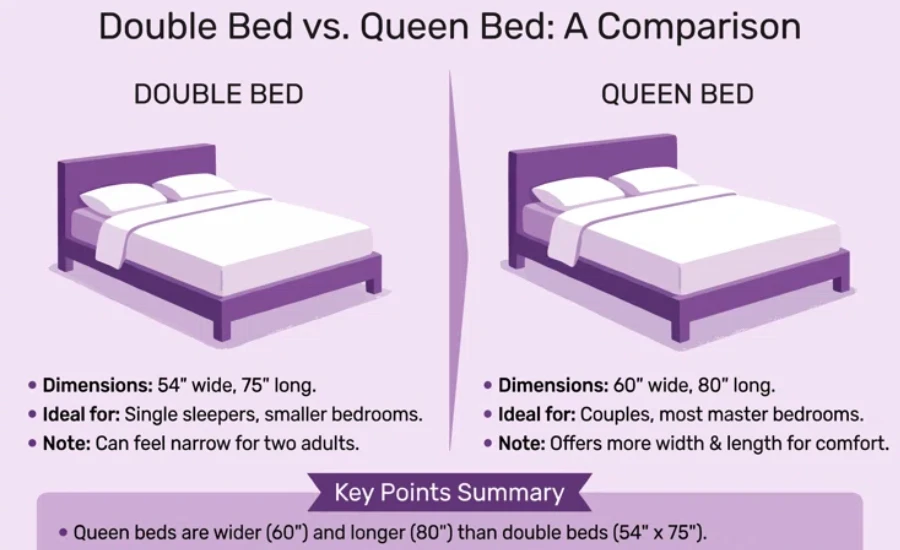
The word “double” implies it fits two people. Historically, it did — because before the 1940s, a 54-inch-wide mattress was the standard size for couples. Then manufacturers introduced the queen in the mid-1940s and standardized it in the 1950s. The “double” kept its name despite being too narrow for comfortable co-sleeping by modern standards. Today it is sold to solo sleepers and guest rooms, quietly demoted from its original purpose.
That history matters for one reason: the double’s dimensions were not designed for modern couples. They were designed for an era when 54 inches was the widest option available. The queen was designed specifically to replace it.
Here is every number and fact that determines which one is right for your room, your height, and how you sleep.
The Dimensions — Confirmed and Consistent
| Dimension | Double (Full) | Queen | Difference |
|---|---|---|---|
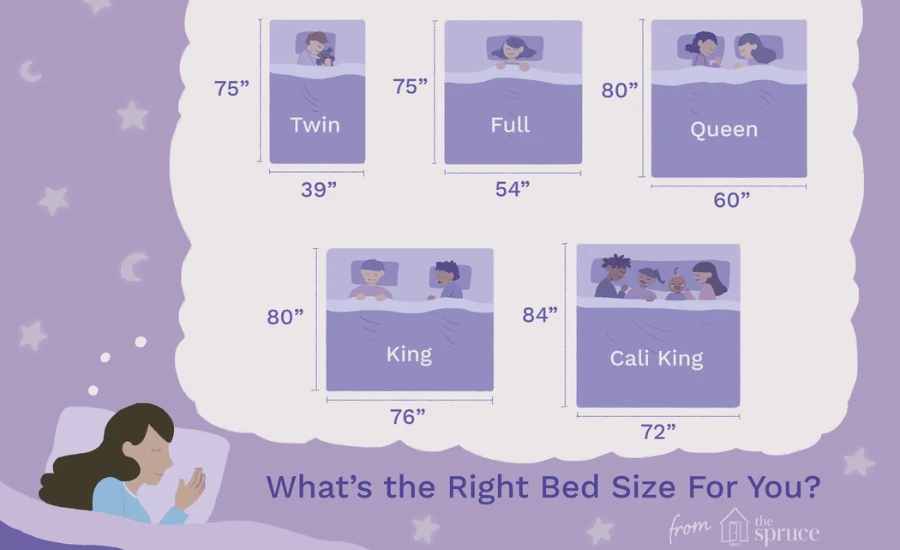
| Width | 54 inches (137 cm) | 60 inches (152 cm) | +6 inches |
| Length | 75 inches (190 cm) | 80 inches (203 cm) | +5 inches |
| Surface area | 4,050 sq in | 4,800 sq in | +18.5% more |
| Per-person width (couple) | 27 inches | 30 inches | +3 inches each |
| Minimum room width | 10 ft | 10 ft | Same |
| Minimum room length | 10 ft | 12 ft | +2 ft |
These dimensions are the North American industry standard. They are confirmed by the International Sleep Products Association (ISPA), by Amerisleep, by Mattress Miracle, by Bedsure, and are consistent across all credible sources reviewed for this article.
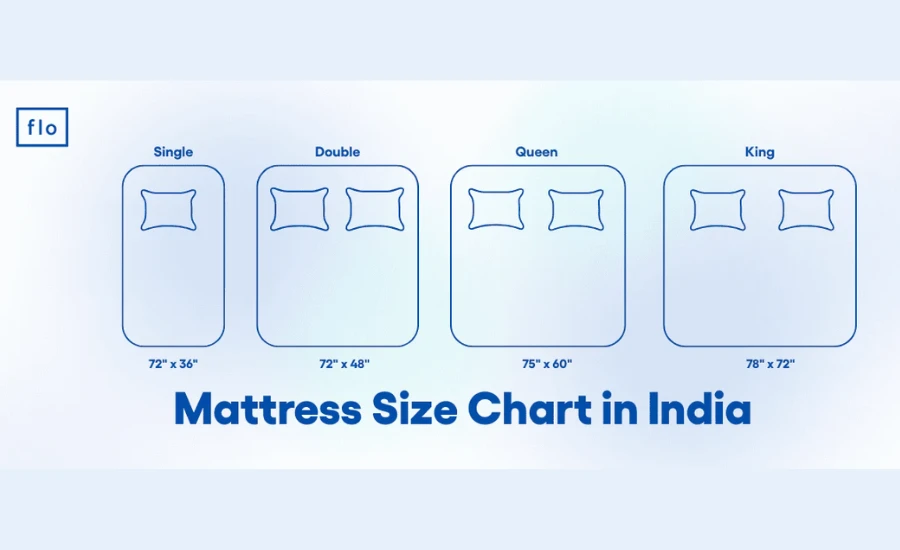
One important regional note: in the United Kingdom, “double” and “queen” refer to different dimensions than in the United States and Canada. A UK double is typically 4’6″ × 6’3″ (135 × 190 cm). The word “queen” is used inconsistently in the UK — it may refer to a small double (135 cm) or approach a super king depending on the retailer. If you are buying bedding internationally, always verify centimetre measurements rather than relying on the label.
“Double” and “Full” Are the Same Bed
This is not widely understood. In North America, “double” and “full” are interchangeable terms for the identical size: 54 × 75 inches. Some retailers use one term, some use the other. The dimensions are identical. The “double” name dates to the 1870s when this was the standard couples’ mattress. The “full” name emerged later as an alternative label for the same product.
If someone says they have a “full-size” bed and someone else says they have a “double,” they have the same bed.
The Per-Person Width Problem
This is the number most people do not know until they lie down on a double as a couple and notice the problem.
A hospital bed is 36 inches wide. A twin bed is 38 inches wide. A double gives each person in a couple approximately 27 inches of personal width — less than a hospital bed, less than a twin, roughly the width of a standard office chair.
On a queen, each person gets 30 inches. Three more inches. It is not a dramatic increase in isolation. In practice, those three inches are the difference between sleeping on your side with your arms in front of you and bumping into your partner, versus sleeping on your side with arms extended without contact.
The queen’s extra 6 inches of total width gives each person 3 extra inches. It is not generous. It is sufficient. The double is insufficient for most couples sleeping nightly.
The Height Cutoff — Where Exactly
Sources differ slightly on the precise height at which a double becomes uncomfortable lengthwise. The practical range from credible sources:
- Under 5’9″: Both double (75″) and queen (80″) work with room to spare
- At 5’10”: A double starts becoming uncomfortable — feet may reach the footboard
- At 6’0″: A double will not work comfortably — feet extend past the mattress edge
- At 6’3″ and above: A queen is adequate but tight — California King (84″) is the better option
The general rule confirmed across multiple sources: your mattress length should be your height plus approximately 5 inches for unrestricted foot movement.
The practical test: If you currently sleep in a double and your feet touch the footboard or hang off, this is the queen’s most decisive argument.
Room Size — The Math That Determines Whether You Have a Choice
Industry guidance recommends at least 24 inches of walking clearance on the two accessible sides and the foot of any bed. Nightstand space on both sides adds approximately 18–24 inches per side.
| Room Scenario | Double | Queen |
|---|---|---|
| 10 × 10 ft room | Comfortable fit with furniture | Fits, but tight with nightstands |
| 10 × 12 ft room | Comfortable, full furniture layout | Comfortable fit |
| 12 × 12 ft room | Lots of space | Comfortable master bedroom feel |
| Under 100 sq ft | Possible but cramped | Not recommended |
If your bedroom is under 10 feet wide, the queen will fit but leave less than the recommended 24 inches on each side after accounting for the bed frame width. A solo sleeper in a narrow bedroom will often be more comfortable with a double than a queen regardless of personal preference.
The Name History — Why It Matters
The double was the dominant couple’s bed from approximately the 1870s through the 1940s. It was what most married couples slept in for nearly a century of American domestic life. The queen was introduced by mattress manufacturers in the mid-1940s specifically to offer couples more space — and it worked. By the 1950s and 1960s, the queen had become the preferred size for new bedrooms.
Today, the queen represents approximately 47% of all US mattress sales. The double has retreated to guest rooms, children transitioning from twin beds, solo sleepers in smaller apartments, and older homes with bedrooms built to pre-1960s dimensions.
The phrase “double bed” persists in everyday English to mean any bed for two people. The actual product called a “double” is no longer the standard for couples — that role belongs to the queen.
Cost Difference — More Specific Than Most Sources Provide
Double mattresses typically cost 15–25% less than queen mattresses from the same brand at the same quality level. In dollar terms, the gap is generally $100–300 at the entry to mid-level price point and narrows proportionally at premium tiers.
Bedding (sheets, fitted sheets, duvets, comforter covers): queen bedding costs 10–20% more and is more widely available. Queen is the dominant size in North American retail; double/full bedding selection is smaller at most retailers.
Bed frames are NOT interchangeable. A double frame will not support a queen mattress. A queen frame will not properly support a double mattress. If you are upgrading from double to queen, budget for a new frame and new bedding — not only a new mattress.
The Most Common Regrets
Three patterns appear consistently across sources that document buyer feedback:
Buying a double for a shared bedroom: Couples who bought a double because it was cheaper frequently upgrade to a queen within two years, spending more overall than if they had bought the queen initially.
Underestimating the height issue: Anyone above 5’9″ sleeping in a double regularly experiences foot discomfort. This is almost always discovered by week two of regular use, not at the point of purchase.
Assuming existing bedding transfers: Queen sheets will not stay fitted on a double. Double duvets leave the sides of a queen exposed. Bedding is size-specific. Changing mattress sizes means replacing all bedding.
The Decision Framework
Choose a double if:
- You sleep alone and your room is under 120 square feet
- Your room is less than 10 feet wide with standard furniture
- The bedroom is a guest room for occasional solo adult use
- Budget is a hard constraint and you are not sharing the bed
Choose a queen if:
- Two people share the bed regularly
- You are 5’10” or taller
- Your room is 10 × 12 feet or larger
- You may share the bed within 2–3 years even if you do not currently
- You sleep restlessly, with a pet, or need space to stretch
The underlying logic: A queen is the minimum recommended size for a couple’s primary bedroom in modern North American housing. A double is appropriate for specific situations where room size, budget, or single-sleeper use makes the smaller footprint the right choice. The decision is not about preference — it is about room geometry, height, and who is sleeping in the bed.
You may also like Media Bias Chart
FAQ — 10 Real Questions
1. Is a double bed the same as a full-size bed?
Yes. “Double” and “full” are interchangeable terms for the identical size: 54 × 75 inches (137 × 190 cm) in North America.
2. How much bigger is a queen than a double?
6 inches wider, 5 inches longer, and approximately 18.5% more total surface area.
3. Can two adults sleep in a double bed?
Technically yes. Practically, each person gets 27 inches of width — less than a hospital bed. Most couples find it workable for occasional use and inadequate for nightly shared sleep.
4. What is the minimum room size for a queen bed?
10 × 10 feet as an absolute minimum. 10 × 12 feet allows comfortable clearance with nightstands. 12 × 12 feet is recommended for a master bedroom feel with full furniture.
5. Are double and queen sheets interchangeable?
No. Queen fitted sheets are too large for a double and will not stay tucked. Double duvets leave a queen’s sides exposed. Always match bedding size to mattress size.
6. Do I need a new frame if I switch from double to queen?
Yes. Double and queen frames have different dimensions and are not interchangeable. A new frame, and likely a new foundation or base, is required when changing sizes.
7. Is a queen better for tall people?
Yes. At 75 inches, a double is too short for anyone 5’10” or above. The queen’s 80-inch length is adequate for sleepers up to approximately 6’3″. Above 6’3″, a California King (84 inches) is the better option.
8. Why is the double bed called “double” if it barely fits two people?
The name dates to the 1870s when 54 inches was the standard couples’ bed size — the only option wider than a single. It became a misnomer when the queen was introduced in the 1940s and replaced the double as the actual standard for couples.
9. Does “double” mean the same thing in the UK and US?
No. UK and US bed terminology is not equivalent. A UK “double” is approximately 135 × 190 cm (53 × 75 inches), slightly narrower than the US full/double. “Queen” is used inconsistently in the UK and does not correspond to the standard US queen dimensions. Always verify centimetre measurements when buying internationally.
10. Which is more popular — double or queen?
The queen represents approximately 47% of US mattress sales and is the dominant size for primary bedrooms in modern North American housing. The double is the second most common size overall but is primarily used in guest rooms, smaller bedrooms, and for solo sleepers.