
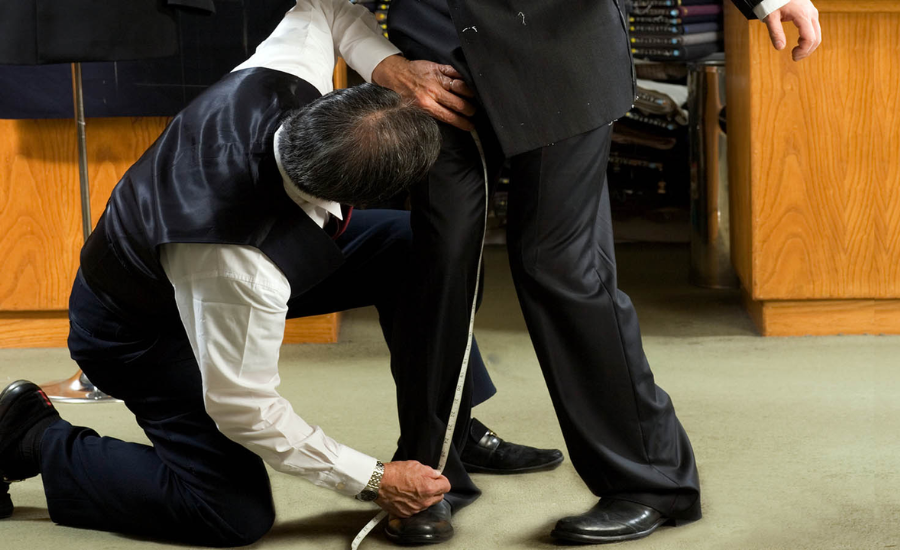
The inseam is the length of the inner seam of a pair of trousers, running from the crotch seam to the bottom hem of the leg. It is not the same as total leg length. It is not calculated from height. Two people who are both exactly six feet tall can have inseam measurements that differ by three inches — because leg proportions vary significantly between individuals even at identical heights.
The only reliable way to know your inseam is to measure it.
How to Measure Your Inseam — Two Methods
Method 1 — From a pair of trousers you already own (most accurate for buying new ones):
Lay the trousers flat on a surface. Smooth them out so they are not bunched or folded. Find the crotch seam — the point where the front and back inner leg seams meet at the highest point between the legs. From that point, measure straight down along the inner leg seam to the hem. This number is your inseam.
This method is preferred because it reflects how a specific pair of trousers actually fits you, accounting for your preferred fit and break.
Method 2 — Measuring yourself directly:
Stand in bare feet (or thin socks — not shoes) on a hard floor with your feet approximately 6 inches apart. Place a hardback book between your legs with the spine of the book pressed firmly upward into your crotch — simulating where the crotch seam of trousers would sit. Have someone else measure from the floor to the top of the book spine. That distance is your inseam.
This method requires a second person for accuracy. Bending forward to read the measurement yourself will compress the book position and produce a shorter, inaccurate number.
Standard Inseam Lengths and What They Correspond To
Trouser manufacturers typically offer inseam lengths in increments of 2 inches. These are the standard categories used by most UK and US brands:
| Category | Inseam Length | Approximate Height Range |
|---|---|---|
| Short | 28–29 inches (71–74 cm) | Under 5’4″ (163 cm) |
| Regular | 30–32 inches (76–81 cm) | 5’5″–5’9″ (165–175 cm) |
| Long | 32–34 inches (81–86 cm) | 5’10″–6’1″ (178–185 cm) |
| Extra Long | 34–36 inches (86–91 cm) | 6’2″ and above (188 cm+) |
These are general guides. The height ranges are approximations and will not apply to every individual — leg proportions vary. The only reliable reference is your own measurement.
To convert inches to centimetres: multiply by 2.54. A 32-inch inseam equals 81.28 cm.
The Difference Between Inseam, Outseam, and Rise
These three measurements describe three different dimensions of trouser fit. They are frequently confused.
Inseam: The inner leg seam from crotch to hem. What this article is about. Directly determines how long the trouser leg is.
Outseam: The outer leg seam from the waistband top to the hem. Always longer than the inseam because it starts higher — at the waistband, not the crotch. The outseam is not commonly used as a sizing reference in retail.
Rise: The distance from the crotch seam to the top of the waistband. Rise determines how high the trousers sit on the body. A low-rise trouser has a shorter rise (sits below the hip). A high-rise trouser has a longer rise (sits at or above the natural waist). Rise is not the same as inseam and does not tell you leg length.
Inseam + Rise ≠ outseam. They are measured along different seam paths and cannot be directly added.
How Trousers Are Labeled — Reading the Size Tag
US and UK jeans: Typically labeled as two numbers — waist measurement × inseam. A label reading “32 × 32” means a 32-inch waist and 32-inch inseam. A label reading “34 × 30” means a 34-inch waist and 30-inch inseam. This labeling convention is standard across Levi’s, Wrangler, Lee, and most denim brands.
European sizing: European trousers often use a single number (34, 36, 38) representing the waist in centimetres, sometimes without an inseam figure — or with a separate “L” designation for leg length. European brands vary significantly in how they communicate inseam. Always check the specific brand’s size guide rather than assuming the number on the label represents inseam.
Dress trousers and suit trousers: Typically sold with extra length (often 32–34 inches) and intended to be hemmed by a tailor to the buyer’s exact inseam. The hem length on off-the-rack dress trousers is not a reliable guide to fit — they are designed for alteration.
Athletic and casual trousers: Frequently sized as S/M/L/XL rather than by waist and inseam. This introduces the most variability — the same “Medium” from two different brands can differ by 2 inches in inseam. Check the brand’s specific size chart, which should include inseam ranges for each size.
The “Break” Concept — What Affects Your Target Inseam Length
Break is the amount of fabric that rests on the top of the shoe when trousers are worn. Different break preferences require different inseam lengths for the same person.
| Break Style | Description | Effect on Inseam |
|---|---|---|
| No break | Hem sits just at the top of the shoe, no contact | Shorter inseam — often 1–1.5 inches shorter than “standard” |
| Slight break | 1/4 inch of fabric lightly touching the shoe | Standard fitted inseam |
| Medium break | 1/2 inch of fabric touching the shoe | Slightly longer inseam |
| Full break | 3/4 inch or more of fabric folding over the shoe | Longest inseam preference |
Break preference is a fit choice, not a measurement error. If you prefer no break and you are buying jeans marketed as “regular” length, they may be too long. Knowing your break preference helps you decide whether to buy one inseam length or the next.
Why Height Does Not Reliably Predict Inseam
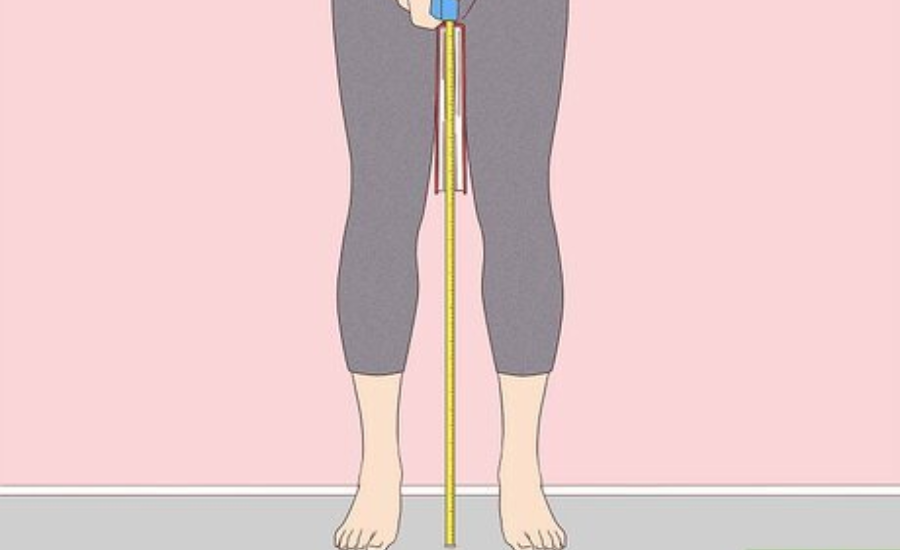
This is the most commonly misunderstood aspect of inseam measurement.
A person who is 5’10” has a total height of 70 inches from floor to the top of the head. Their inseam might be 30, 31, 32, or 33 inches — depending on how much of their height is torso versus leg. Tall people with long torsos may have shorter inseams than shorter people with long legs.
The general formula inseam ≈ height × 0.45 to 0.47 produces an approximation, but this range represents a variation of about 3 inches for a person of average height — significant enough to mean the difference between trousers that are two sizes too short and two sizes too long.
Never buy trousers based solely on height. Always measure.
The Most Common Measurement Mistakes
Measuring with shoes on: Shoes add 0.5–1.5 inches of height, producing a measurement that is too long. Measure in bare feet.
Not pressing the book firmly: If the book spine is not fully pressed against the crotch, the measurement will be shorter than the actual crotch-to-floor distance. The book simulates where the crotch seam of trousers would sit — it needs to be pressed firmly upward.
Measuring the outseam instead of the inseam: Running the tape along the outside of the leg produces the outseam, which is typically 4–6 inches longer than the inseam for the same person.
Assuming the inseam on existing trousers reflects your actual inseam: Trousers with a 32-inch inseam that you have been wearing with a full break may not mean your inseam is 32 inches — it may be 30.5 inches with the extra length creating the break you wear.
Conversions and International Reference
| Inseam (inches) | Centimetres | Notes |
|---|---|---|
| 28″ | 71 cm | Short |
| 29″ | 74 cm | Short |
| 30″ | 76 cm | Regular short |
| 31″ | 79 cm | Regular |
| 32″ | 81 cm | Most common US regular |
| 33″ | 84 cm | Regular tall |
| 34″ | 86 cm | Long |
| 36″ | 91 cm | Extra long |
You may also like United WiFi
FAQ — 10 Real Questions
1. What is an inseam measurement?
The length of the inner seam of a pair of trousers, running from the crotch seam to the hem at the bottom of the leg. It directly determines the trouser leg length.
2. How do I measure my inseam at home?
The most accurate method: lay a pair of trousers you already own flat, and measure from the crotch seam to the hem along the inner leg seam. To measure yourself: stand in bare feet, press a hardback book spine into your crotch, and have someone measure from the floor to the top of the book spine.
3. Can I use my height to estimate my inseam?
Only as a rough approximation. Multiply your height in inches by 0.45–0.47. For a 5’10” person (70 inches): 70 × 0.46 = approximately 32 inches. However, leg-to-torso proportions vary enough that this estimate can be off by 2–3 inches. Always measure rather than estimate.
4. What does “32 × 32” mean on a pair of jeans?
Waist measurement × inseam measurement, both in inches. 32 × 32 means a 32-inch waist and a 32-inch inseam. This labeling convention is standard for most US and UK denim brands.
5. What is the difference between inseam and rise?
Inseam is the inner leg length from crotch to hem. Rise is the distance from the crotch seam to the top of the waistband. They measure different dimensions. Rise determines how high trousers sit on the body. Inseam determines how long the leg is.
6. What inseam length should I choose for different heights?
General guide: under 5’4″ → 28–29 inch inseam; 5’5″–5’9″ → 30–32 inch inseam; 5’10″–6’1″ → 32–34 inch inseam; 6’2″ and above → 34–36 inch inseam. These are approximations — measure your own inseam for accuracy.
7. What is break and how does it affect inseam choice?
Break is how much trouser fabric rests on top of the shoe. No break means the hem just grazes the shoe and requires a shorter inseam. Full break means substantial fabric folding over the shoe and requires a longer inseam. Your break preference changes your target inseam by up to 1.5 inches from the same body measurement.
8. Why are dress trousers sold with longer inseams than I need?
Dress and suit trousers are designed to be hemmed by a tailor to your exact length. They are sold long to accommodate a range of inseam lengths. This is different from jeans, which are cut to specific inseam lengths and typically not hemmed after purchase (though they can be).
9. How do I convert inches to centimetres for international shopping?
Multiply inches by 2.54. A 32-inch inseam equals 81.3 cm. A 30-inch inseam equals 76.2 cm. European size charts often list inseam in centimetres — always check the specific brand’s size guide rather than assuming European numbering systems match US labels.
10. What if the inseam I measure falls between standard sizes?
Buy the longer size and hem to the shorter length if needed, rather than buying the shorter size and having trousers that are too short. Most trousers can be hemmed by a tailor or at home for approximately $10–20 and 20–30 minutes of work. Trousers that are too short cannot be lengthened.